We’re back with a bonus episode on negotiations, because apparently four weeks of talking about contracts, deals, and difficult decisions just wasn’t enough.
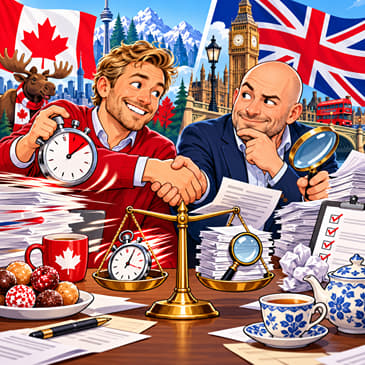
This time, we’re tackling due diligence. How much homework should you really do before signing on the dotted line? And at what point does being thorough turn into chasing certainty that simply doesn't exist?
We explore the dangers of rushing into agreements, the equally frustrating trap of analysis paralysis, and why understanding the people behind a deal can be just as important as understanding the numbers.
Along the way, we take an unexpected detour into British political conferences, what they can teach businesses about running better events, and why building genuine relationships delivers value long after everyone has gone home.
It's a bonus helping of Tea and Timbits, complete with practical business lessons, a few tangents, and the occasional reminder that even the best preparation can't guarantee a perfect outcome.
[00:00:18] Welcome to the Tea and Timbits podcast. I am going to stop the music from repeating again. I did it again, Andy. I did it again. Just so you have, if you haven't picked up, Andy, I'm going to host this episode. You've got to tell the story in about 20 seconds. I figured that one out. As the intro music cut in, I was like, okay, Scott's got this one. I, I'm Scott and I am coming to you today from Fenelon Falls, Ontario.
[00:00:46] That sounds lovely. I'm Andy coming to you from the United Kingdom, nowhere with any fancy names or locations. And as I mentioned, this is the Tea and Timbits podcast, Global Perspectives on Business Development to help you prosper. We have been spending the month of September talking about negotiations and it's been a spicy month. It's been interesting. I've been having a lot of fun talking about this theme.
[00:01:12] It seems like we could probably spend an entire podcast just talking about this every episode. But one of the nice things about September, at least nice for listeners who are enjoying this topic as well, is that there's an extra week in that month. It's longer the way the calendar falls and we plan our content in four week laps and there's an extra week to fill this month. So we just do bonus episodes. We just kind of riff on the topic of the day.
[00:01:41] So we're going to get a little bit more into negotiations. I think we're going to talk a little bit about sort of the due diligence process that you may decide to go through or not in that kind of a moment. And hopefully I've stalled enough and given you enough space to think of a story that's top of mind. Andy, I'm going to pass it over to you.
[00:02:05] So care to share with us some thoughts about what's been coming and going in your life lately that's worth reflecting on together? Well, I didn't need the long run up. I was well prepared with the story for this episode because I'm in the UK at the moment. It's party political conference season.
[00:02:27] And because of the work I do in maritime defense and offshore energy, of course, all of those industries that I've dabbled with for years and years and years, they are all actively involved in what the government are making decisions about on a big scale. So being in the room, being able to hear what's coming and be able to meet the right people and influence that is, of course, a big part of what I need to do and what I have done for years,
[00:02:57] not only in the UK, but also in other countries. But at the moment, it's a UK party political season. And naturally, I have my own preference of a political party. But that doesn't affect the importance of attending these events from multiple parties. I mean, of course, a couple of them which are more sensible than others. But anyway, I love how you're dancing around this.
[00:03:25] And I can't quite figure out if that means that you went to the one that you like or you went to the one that you were less enthusiastic to go to. But anyway, I digress. Carry on with your story. I went to the one that I like and I've contributed to the one that I'm less enthusiastic about. And I listened with great amusement to the offers from the other parties, which are, of course, less mainstream.
[00:03:49] But anyway, the purpose of this story is literally just to say that because I'm, you know, I'm coming at this from a business perspective and I get involved a lot, as you know, with conferences and events and things in the business world anyway. So I have a good perspective and a good experience of how a lot of these events are run.
[00:04:12] And then I have a very different experience when it comes to the political side of things. And what I find interesting is that the political conferences are often run by people who are there to prepare big events and things that are not necessarily always involved in doing business events.
[00:04:37] And regardless of which party you're a fan of, I will say the mainstream parties do a much better job at arranging business days, business events and making those things flow than a lot of the business events that I go to that are highly specialized and arranged by people who are involved in the business world.
[00:04:58] And I find it very interesting because there are always very senior communities of business professionals at these events and involved in these events. And yet none of that experience that they have, that's obviously going to be a lot more positive, transitions across into the business world afterwards. And if the very basic element of arranging events doesn't carry across, how much of the other stuff actually carries across into the business world?
[00:05:26] And I want to tell this story because I find these events incredibly valuable. I've always found events, meeting people face to face, getting to know people in there, you know, when they're sort of really there focused on what they're trying to do. And you've all got a shared agenda and a shared reason for being there. I always find those events to be incredibly valuable. And the party political ones or industry focused ones are no different.
[00:05:51] But I do think that people could benefit from learning from the different ones that they go to and trying to build on that and take those into the future and into the other events that they're involved with. Because the political world, bizarrely, do a very good job of arranging events. And I think it's maybe because of their involvement in the media world that they're a little bit more mindful of how things could appear from the outside and, you know, what things could look like.
[00:06:21] And so they make a slightly different effort to industry. But industry is present at all of these. So industry could easily learn from it and make much, much better events. Yeah, that's all I have to say. Interesting. I wonder also it has something to do with the fact that in politics, it is so critical for you to have good community engagement. Like whatever your community is.
[00:06:47] You know, the business community, the local community, those different sort of, you know, audiences and whatnot. And they're just there. That is full time what they do. Yeah, that's true. And I kind of like thinking of it that way.
[00:07:07] And I think so often in the business world, we neglect the value of that kind of what I'm just very broadly labeling as community engagement. Yeah. I think that's what events really do. And obviously, I don't mean it from a business perspective in terms of you need to be good sort of community supporters and you need to give back to your community.
[00:07:37] Those are that's what that's a wonderful thing to do and a good value to have in a in a company. But I mean it from the perspective of your client base, your partnerships, your vendors and making sure that everybody feels like working with you is a value beyond the delivery of whatever it is that you are paid to offer. Yeah, you have a very valid point there.
[00:08:04] And you've triggered something inside me on reflection that that makes me think that there is there is an obvious difference between the political events and the business events. And that is in the business world, if you go, I'm just going to take a random one. I don't know if it exists or not, but just a random one like green, sustainable offshore wind supply chain event. Sure.
[00:08:33] If you if you put that out there and said that's what you're doing and then you reached out to all of the companies in the industry and said we're doing this event. You know that anyone working in that industry most likely is going to want to either attend or participate because they want to be seen as being part of that community. Right. The political events have the opposite situation. They want and need as much engagement as possible.
[00:09:01] And it's very hard to get that because, you know, within any business organization, you're going to have people who have very different political views and perspectives. And yeah, the political parties have to constantly try and sell and promote and convince people to to join and participate in their event. And so there is a difference there because you're selling it. You make more of an effort and you make it a good event.
[00:09:25] You make it attractive for people to attend rather than just calling it something that's going to make people feel they need to attend because they're in the industry. Yeah. Yeah. But bringing it back to the point that you made, I think that that there's a there's a lot of benefit that could come from reflecting on on the difference there.
[00:09:45] And what in the business community we can take away from successful events of that nature to the benefit of our our our own businesses. So, yeah, I think that's a great reflection. So we were we were just kind of spitballing how we would sort of extend our conversation of the month from contracts and negotiations. It was really about negotiations.
[00:10:13] And we sort of started to riff on the idea or some themes around due diligence. And then before we exhausted our best ideas off camera, we decided to hit record. So the reason that it got me kind of wound up and and excited is I think that there's. There's a there's a situation that I have seen.
[00:10:44] Um, lately on on both ends of this spectrum. One is. I think I even mentioned it in some of the stories that I shared over the month. One is let's just get going. Let's just get going. Come on. Like, just sign the contract. Let's just get going. And that's kind of, you know, not enough due diligence.
[00:11:04] That's just kind of like a little bit cavalier and haphazard and is bound to, you know, be a be a negative risk, a high, high impact risk.
[00:11:16] Um, but one story that I, uh, that is only just coming to mind now that I think triggered this, this thought process for me was the, was the opposite where you're, you're seeking a certainty and a clarity and a validation that simply does not exist. And you're trying to increase your confidence.
[00:11:41] You're trying to justify a decision based on evidence that is meant to emerge through the project or perhaps may never present itself clearly. So your due diligence effort is, um, for lack of a better term, a waste of time because you're seeking, you're seeking.
[00:12:07] You're seeking something you're, you're looking to give yourself, um, a confidence and a clarity and a, and a reassurance and a guarantee that, um, that doesn't exist.
[00:12:22] And you have to, at some point recognize that, um, what, what you're trying to do is not eliminate all risk, but to be aware of where some of those gaps are. Um, and then make a decision about whether you're comfortable going into the process, ready to manage those risks as opposed to address them before the contract gets signed.
[00:12:50] I think that applies for every element in business overall, really, because, you know, when you're, uh, hiring someone, for example, you would go through a, a type of due diligence in terms of, uh, checking a person's background.
[00:13:07] But I often find in similar situation to what you just described that many businesses when recruiting people, well, they'll often go through a lot of, um, very past focused due diligence where they are constantly trying to find that one story, that one experience, that one, uh, success.
[00:13:29] That could potentially tie into what the company is trying to achieve as opposed to building a system where they can actually validate against future goals and future opportunities and skills and, and, and things like that. And that, and that, that should apply throughout everything, right from, you know, when you recruit someone to when you're negotiating the biggest deal the company has ever had.
[00:13:56] You don't want to be looking at, uh, you don't want to be just looking at what the company has done. You do want to look at that, but you don't want to just look at that because then that would mean that you'd never work with any startup. You'd never work with any company that's a great idea.
[00:14:10] What you want to see is clear evidence or convincing evidence, at least, uh, that, uh, it's demonstrating the ability to achieve the goals that you're, um, you're trying to achieve and the, the infrastructure, the systems, the people, the processes, and the, uh, everything around that entire delivery infrastructure exists and is going to exist.
[00:14:40] Throughout the period of time. But as we talked about throughout this negotiation thing, it's got to be very clear what the goals are, what needs to be achieved and how it needs to be achieved. And then the due diligence needs to tie into that of, uh, you know, is that even realistic? Is it possible? And what is it that you are actually trying to achieve so that after the contract is signed, nobody's coming back and going, oh, but we thought you were going to be doing this for us.
[00:15:09] Or we thought that you would be able to achieve this. We thought that if we got this solution from you, it would help us to achieve this thing. Well, that's, that's not the same. And that's where the clarity, this due diligence and this, um, communication up front ahead of the negotiation all ties in together and it all matters. And it's all an integral part of it.
[00:15:30] And I think part of what needs to be brought into focus when you're going through that, that phase of negotiation, um, is the, the, the realistic timeline.
[00:15:48] What, what are we trying to achieve on what timeframe and what are the real, the real deadlines as opposed to the manufactured ones and the sort of the artificial ones. Um, and I think that timelines and deadlines are incredibly valuable for, for achieving results.
[00:16:15] Um, without them, you, you can end up just happily spiraling around and, and, and, and spinning your wheels and, you know, wasting time, uh, you know, getting, getting to a, a point of confidence that, that will never, that will never come.
[00:16:33] Um, but on the flip side, um, sort of a, a, a, a, a, a self-imposed deadline and artificial, um, uh, deadline, uh, can, can add pressure, angst, anxiety, and, um, uh, and, and, and, and, and an undesired outcome for, for all parties.
[00:16:56] Um, and then it also ends up sort of manipulating, um, the, the, the, the process in certain, in certain cases where one party is like, yes, but we have to sign by then. So just sign or, um, you know, or, or, or I have these changes now and this is it. As long as you just sign now, like, like I've seen that. And it's just, um, I don't know.
[00:17:19] It, it, I guess what I'm also saying here is that in the due diligence process, it is also a good opportunity to, to test the working relationship. Are we being open? Are we communicating and whatnot? Yeah. Yeah. No, that, that, that part of the due diligence do the due diligence is, uh, one of those as well, um, is, uh, is knowing whether or not your, uh, cohost on the podcast can actually talk properly.
[00:17:49] Uh, if that is the case, then, uh, you can host a podcast and have a really good conversations and, uh, hopefully our listeners, uh, will forgive me for my, uh, misstep there.
[00:18:00] Uh, but when you are doing the due diligence, it is very important that you, uh, check that the working relationship and the people who are involved in delivering the actual solution are going to be able to work with each other because without that, it doesn't matter how good the negotiation process has been, how good the process has been with the commercial teams before that, how practically involved you have been in checking, you know, the financials.
[00:18:30] Financial stability, the, uh, the deliverables. But if the teams responsible for actually delivering can't work with each other, then it is going to fall apart. And so, you know, checking, several things like that are incredibly important and that will test the relationship and that will test the validity of the contract as well.
[00:18:49] So do you think that there is a mechanism for identifying the necessary level and rigor and detail that should be appropriate when sort of doing quote unquote due diligence? And I say quote unquote, because there's no template for this. It just means you're getting the confidence that, you know, so how do you know?
[00:19:13] I think it is, it is very important to, you know, use your experience as a business professional. And if you don't have that, then working with someone who does or bringing someone in who does, because understanding those potential pitfalls, those potential breaking points, those potential challenges and knowing what to look for. And therefore focusing on that and being able to address that is what is going to make the difference.
[00:19:40] And that's how the due diligence process should work, whether it's, you know, whether it's you and the commercial team, whether it's a management or whether it's an external party. It is incredibly important to engage the right people in that process of the due diligence. And it will often fall into the legal teams, certainly having a legal team involvement, but it shouldn't exclusively be with them. It really should be people who are on the ground who have experienced the challenges as well.
[00:20:09] And you should have a team and make sure that that team come together and they meet regularly and they look at the potential pitfall, the challenges and their past experiences and they bring those into the room. And it's not to say that it should be one of these, you know, mudslinging events where you get everyone in the room. Well, when I worked with that company 15 years ago, they did this thing and it really upset me. And so I'm never working with them again. And you'll get people like that.
[00:20:34] And those are valuable people as well, because it's good to know that because you can address that with the company and say, well, actually, one of the people on the team has a little bit of a concern because of this situation. How have you dealt with that? What has happened since then to mitigate that situation from happening again? And so on. But that is the method that I encourage my customers to follow when they're doing these major negotiations and looking at due diligence.
[00:21:00] And I think that just to close out and pick up on a point there is I think it's really important when you're going through this to to. Make sure that you are aware of the emotion in the room as much as the the substance and the fact not that.
[00:21:26] And I guess that's what I'm trying to say is, is that that lived experience is just as much part of what you need to be evaluating and incorporate and make room for and bring into that conversation as well as the as the technical specificity, whatever that means for you in your circumstance. If you don't fold both in, you're just you're just signing up for challenges and trouble down the road. Yeah, absolutely. Thank you very much. Well, well, there you go. Thanks, Andy. Appreciate it.
[00:21:55] Good reflection on on on on different perspectives on building good events and how to make sure that you can get your your due diligence done appropriately and and effectively for both parties. Always a pleasure, folks. If you want to go through our back catalog and learn a little bit more about us, get in touch. We'd love to hear from you. Please go to T and Timbits dot com. Catch you next time, Andy. Thanks again. Thank you.
[00:22:25] Thank you.