
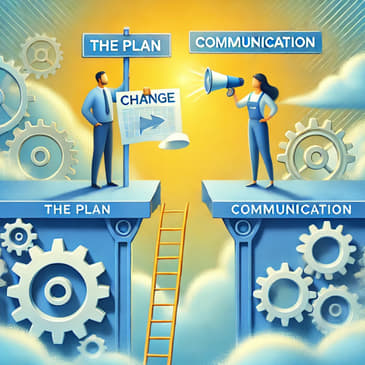
🚨 Change is inevitable, but miscommunication doesn’t have to be! 🚨
In our latest Tea & Timbits episode, we’re talking all things change communication—because let’s face it, we’ve all been guilty of overloading our teams with info (or not giving enough) at some point.
We explore:
🎯 Why the "why, how, and what’s in it for them" is your holy trinity.
🧠 Balancing the logic AND emotions of change.
📢 How pacing and tailored communication can save the day.
💬 Getting feedback loops right to build trust and engagement.
Whether you're leading the charge or just trying to keep up, this episode is packed with real-world tips to make change less scary and more successful.
Give it a listen, and let us know your go-to strategies for communicating change effectively! 💡
[00:00:18] Well hello everyone, here we are halfway through the month of January and this is another episode of the Tea and Timbits podcast. I am Andy. Hello everybody and I am your other host Scott coming to you from the deep cold snowy Toronto as it is in the middle of January. Love it. Best time of year I think.
[00:00:44] This is the Tea and Timbits podcast where we focus on global perspectives on business development to help you prosper and sometimes we get to do it in the snow and that's fantastic. Thank you. Thank you for finishing our opening there. I was just saying that yes, the winter is fun. I took my daughter out into the snow with her friend last night.
[00:01:05] I just let them play while I was kind of walking the perimeter of the park and feeling very good about it until the sun went down and then the temperature dropped that much more and I could not get the cold out of my bones. I got back into the house last night. It was just stayed with me right into bedtime. How cold has it been? Celsius it's been as cold as about minus 18. Yeah, that's when the snow gets nice and crisp, isn't it?
[00:01:34] And if you get the clear days with it, yeah. It squeaks when you stand on it. Yeah, and the crystals in the air and stuff is lovely. We do have a good snow covering at the moment and in the heart of the city in Toronto. That's actually not always common. So the surrounding areas have tons, but we have just enough for the kids to be distracted and enjoy it. Superb, superb.
[00:02:00] Well, today we are talking about communicating for change. And before we get into that, Scott, I think you might have one or two stories for us, but only one for this show, if you don't mind. And it has nothing to do with squeaky snow. Thank you, Andy. Yeah, it's been a sort of very fast and furious start to the new year on the business front here.
[00:02:27] Lots of projects kicking off, lots of new initiatives starting. And a recent project kickoff sort of got me thinking about what it means to both ask if the plan is understood, but also agree that you understand the plan. Right. So it's I know we've talked about accountability and that sort of contract.
[00:02:56] So I do always try to think about it from both both angles. But when in this scenario, it was all good, but it got me it got me thinking about sort of what does it mean to say, here's the plan? And do you understand? Are we good to go? Which is kind of typically, I think, how the question gets posed. Here it is. Here's what we're going to do. In the case that I'm reflecting on, it was a very detailed plan.
[00:03:24] It was a lot of technical specifications and a detailed itemized work plan with task descriptions. And we took the team through it all. And then it was like, OK, so are we good? Do you know, can you take this away, reflect on it, come back and let us know if you got any feedback or questions? And you could tell that in some cases there was deep consideration and careful consideration.
[00:03:53] And you could tell that in other cases like, yeah, that sounded great. Good. Yeah, I understand. We're good. And so I just think it's worth sharing that so that we can all think about what it means when you're asking somebody for that kind of alignment or when you get asked to weigh in or agree to something of that nature. So I kind of came up with a spectrum. I wrote a blog post about it on the company's website.
[00:04:23] But, you know, it starts with just was the plan articulated clearly? Like, did you just understand the words that came out of my mouth when I said it? That's one thing. The next thing is, have you had a chance to really absorb all the information? Have you spent quality time with the detail and let it kind of sink in? That is sort of in my spectrum, the next step up.
[00:04:48] The next step after that is, did you get a chance to then apply that understanding, that immersion to the business context? Did you reconcile that against the problems, the challenges that it is set out to solve? And then did you give properly balanced informed feedback to then be able to get to actioning that plan? So I thought I'd share that for what it's worth.
[00:05:12] I think we've been on both sides of being asked and being the asker and what it means to properly reflect on the details of a plan. Very good. Very good. I think that leads us quite nicely into today's topic. I think it does. The whole communication is key in all areas of business and in particular when it comes to change. What would be your desired outcome from today's topic, Scott?
[00:05:43] To just like not skip over what I think we all understand already. Like we're going to be doing, I think, a bit of a remedial reminder here in this episode because we've all heard this kind of stuff before. So my hope is that you do just take a minute to stay with us on this conversation and go, right, you know what?
[00:06:06] I need to be a better practitioner, a better sort of follower of those best practices. I am guilty of, you know, forgetting it, being too wrapped up in the moment, all that kind of stuff. So that's what I hope. I mean, I think it's not the message. I think it's just the moment in the message that I'd like to see us come away with sharing. Makes a lot of sense. Makes a lot of sense.
[00:06:34] If we go straight into it, what would you say are a couple of the more common communication pitfalls that people fall into when starting a change process? Well, maybe before I get there, because as soon as you asked me that question, I started thinking of sort of all the classic and sort of following on what you asked about desired outcome. Like, what does it mean to communicate change, right?
[00:07:01] So we've all heard, like, get all the right people on board and share it with the right stakeholders. And that's kind of the message that I think I was referring to saying, like, we've all heard this before. And then I think it's also important to make sure that it is digestible and relevant. And it doesn't necessarily have a positive impact on everybody that's involved. You need to sort of think about that.
[00:07:26] And then I think also, we're better at doing this for the clients that pay us to guide them through this process than we are for ourselves. So don't... Yeah, that's always the way. Don't let down your own best practices because you're doing it for yourself in those moments as well. So I don't know. Now, circling back to the question, like, you know, where do I think some of the pitfalls happen?
[00:07:54] To delay addressing that question one more moment, do you think there's any other elements of communicating change that I didn't sort of include in that summary? I think your summary there is essentially, you know, the why, the how, and the what's in it for them. You know, it's the three key areas, essentially, that have to be there in order to have that effective communication.
[00:08:22] But one big thing that I think you picked up on there, which is essential, is that forgetting to do for yourself what you're able to do and often do for others. It's taking that step back and looking at yourself as if you were a client and treating yourself as if you are a client and handling that in your own business.
[00:08:44] Yes. I think the, you know, when it comes to, when it comes to the communicating, it's, it's, it's finding that balance, isn't it really between too much information and too little information. And, and that's why I think if you stick to those sort of three areas that you touched on there, which is, you know, why, why are you doing the change? How are you going to do the change? And, you know, what's in it for the people affected by the change?
[00:09:12] Because, you know, everyone wants to know, how is this going to affect my job? And what support will I have in making this happen? That's really all people care about. And if it means they're going to end up with more work, well, then they want to know what's going to happen to their normal work. If it means they're going to end up out of work, well, then they're probably going to resist it emotionally as well. And also, you know, are there going to be people around to help with that change process?
[00:09:40] Because not everybody's familiar with doing something new, you know, that's why it's a change. So, right. I mean, I'm going to add sort of, or just pick up and clarify one thing that you just mentioned there is, I think in this process, it's really easy to focus on the logic. And, well, here it is. We've done our homework. You've hired consultants. You've thought about this yourself. You've set time aside and planned for this change.
[00:10:08] And it seems bloody obvious that this is a natural, you know, acceptable, if not optimal solution to why we're implementing change. And that once you've come up with the solution and deliver it, it will be bloody obvious to everybody else that's in your audience. But they haven't gone through that journey of discovery and understanding. Correct. Yeah.
[00:10:37] And I think that that doesn't mean you need to then rewind and bring everybody along for that journey. I think depending on the size and impact, there is value in a certain amount of that contextualizing the change and whatnot.
[00:10:55] But at the very least, just getting ready for the fact that this is going to be both a logical procedural moment, but a very emotional one as well. And if you don't put those both in the balance, then it's going to be more challenging for you. Absolutely. Absolutely. I think we mentioned a few of those things on the previous episodes on change as well.
[00:11:23] So it's very good to reiterate those and focus on those. If we circle back a little bit to some of the common pitfalls that, you know, that can occur during that change communication. I touched on one of them there, which is the, you know, too much information, you know, overloading people with information. But, you know, perhaps by contrast, then under communicating is another one, you know, as you've kind of suggested there as well,
[00:11:50] is that for the leadership team and those involved in development of the change process, they already know all these things. They've already answered all these questions. They've been through that emotional journey, but nobody else has. And so they're approaching it at a very different place as, you know, anyone else. So I think being aware of that and also, you know, yeah, I think I touched on that as well.
[00:12:14] The failing to ignore, not failing to ignore, but ignoring the emotional reactions that can come up as a result of implementing this change and introducing it to people. Missing those is a very bad idea. Yeah.
[00:12:29] I think there's something in here about pacing and timing and giving room and space to get the team and the stakeholders at least, not necessarily aligned, but just engaged, I guess.
[00:12:57] Like, back to my story, like to comprehend, like what this all means. And if you just kind of go, boom, here it is. And it's clear and it's good. And we've tested it, you know, the idea with our committee or whatever. You need to roll it out in a digestible way.
[00:13:26] And that involves like, you know, restating the challenge or the opportunity. Like, what led us to this moment? We've all, we all know what it is. That's why we're here. But wait a minute. Let's talk about it for us for a second. Like, let's just put it out there at the beginning and make sure that everybody remembers. Oh, yeah, right. We're solving for that. Because otherwise people start sort of imagining their own scenarios or they're not imagined.
[00:13:56] Like remembering, calling, reflecting on, you know, that aren't necessarily strongly correlated with the core objective of why you're taking on the change. So I think that, in my mind, is one of the biggest mistakes pitfalls is going at too fast a pace. So you still need to do all the right amount of over-under communicating and watching out for that.
[00:14:24] But then there's also the pace at which you're not going to do all the time. And some people are good at sitting with the plan and rationalizing it and comprehending all of it. And some need visuals and conversation and discussion.
[00:14:45] So being aware of the different personalities, profiles of the people that are involved in this can help, I think, as well. Absolutely. No, I couldn't agree more. And I think, you know, this is exactly some of the things that you mentioned at the beginning as well about the repetition, you know, repeating that message. Start communicating as early as you can, you know, and just providing those regular updates.
[00:15:13] Like you said, I don't know, town hall meetings, you know, emails, memos, infographics, timelines, because everybody's different, as you say. And so they'll, you know, have been told the information in four different ways. And then suddenly they'll see an infographic and go, oh, I get it now. Yeah. And other people will see all the infographics and things like that. And it will only be in a town hall meeting that they'll actually go, now I get it. So it's different.
[00:15:37] And I think it's also about making it clear what you need people to do with the information that you're delivering along the way. What I've seen is you share a thought or an idea and some people will take it as a fully baked, you know, actionable. Yeah. Yeah, you've got to have your feedback loops, haven't you? You've got to make sure that there is that communication. Yeah. And you're like, whoa, whoa, whoa, hold on.
[00:16:02] That was just like a confidently articulated idea. It didn't mean go change the way you're doing it yet. Like we're not there yet. But some people, those project managers, those action-oriented leaders, they're going to start thinking about what they need to do and how it's going to infect. And they're going to try and get ahead of it. But, you know, that's good at a certain point in the process, but not necessarily in earlier stages.
[00:16:32] No, that's right. And I think as well on that communication. Absolutely. Sorry about that. Yeah. Yeah. We're both so excited and enthusiastic about this topic. It's great. But again, you know, I think the key is as well to remember to measure that effectiveness of the communication, you know, getting that feedback from the employees and the people affected by it. You know, do you have enough information? Do you understand what's going on?
[00:17:01] Do you understand your role in it? Are you getting the necessary support? Or, you know, is there something we can do different? Are we going down the right path? What are your concerns? Just making sure that that is part of that change process because then people do feel more involved in it. And if they feel more involved in it, they're more likely to embrace it. And it's more likely to be a success in my experience. Couldn't have said it better. There you go.
[00:17:27] I think we've both been saying pretty much the same thing from a different angle the whole time, but it's great. It's good. Yeah. Any more thoughts on this one or do you want to conclude this episode and save some other little bits for the rest of it? Yeah. I think in terms of like the core concept here, communicating change in our, you know, we've covered the basis here. It really is just about the sort of fundamentals.
[00:17:56] And again, coming back to what I said off the top, probably we all know all of these things. But hopefully anybody that's spent the time to listen to us here today just kind of goes, oh, yeah, I could do that better. Oh, yeah. You know, maybe that would be a good thing to think more about or implement more strongly. Yeah. Yeah. And that's why I enjoy doing these episodes as well, because for me, it's, you know, to refresh it all the time.
[00:18:25] I have to think about it, you know, one of the best ways of learning and reinforcing skills that you already have is by teaching them to others. So, you know, when you say we're going to do these episodes, then I have to go away and start thinking about, OK, so I know what I'm doing now. How do I communicate that? How do I discuss that with other people? And that's exactly the same with people in the change management process. You've got to make sure that you can figure out a way to communicate it with the other people, with other people, not just yourself. Yeah. There you go.
[00:18:57] Well, if you've enjoyed this episode or any of the other episodes that you've listened to, because we're sure that you're avid fans. But if you are new to us and you're not an avid fan yet, go to TNTinbits.com, listen to some old episodes and become an avid fan and get in touch with us at any of the communication ways that are on there. And also you can get in touch with us as well and have a chat, share your opinions and do anything you like with that information that's available there and hopefully become really effective at your jobs and everyone else's jobs too.
[00:19:28] Thanks for closing it out, Andy. Thanks, everybody.