
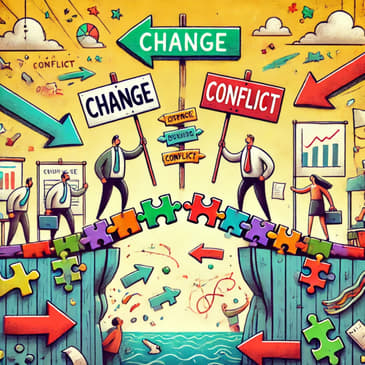
Change might be inevitable, but managing conflict during it? That’s a whole different ball game. This week on Tea & Timbits, we talk about the often-messy, always-challenging process of managing conflict in business transformations.
From unpacking human resistance to change to sharing real-life anecdotes (yes, birthday dinner plans gone sideways can teach us a lot!), we’re here to guide you through the emotional and practical steps of navigating conflict with empathy and clarity.
Whether you’re a leader implementing change or someone caught in the middle, this episode offers relatable stories and actionable tips to help turn friction into progress.
Listen now and let us know: What’s your go-to strategy for handling resistance during change?
[00:00:19] Hello everybody, I am one of your hosts Scott coming to you from Toronto. And I am the other host Andy coming to you from the United Kingdom on my birthday. Hey buddy, happy birthday, I didn't know that. Thank you very much. I'm sure you did if you checked your calendar. And the package is on its way. Yeah, of course, of course.
[00:00:40] There was a I think it was a Saturday Night Live skit that I get from like the 80s that came up at my feed about like a courier service that would that you could that you could use to send things after you after the date and they would make it look like it got lost. And you pay them extra money and you and they'll backdate the postage stamp and they'll make it got dropped in a puddle.
[00:01:06] And then I was like, we need that. This is Tea and Timbits Global Perspectives on Business Development to Help You Prosper. We're still in January, Andy's birthday month favorite month of the year. And we're talking about change as it pertains to businesses, the sales process. We're going to talk about handling conflict in that process today.
[00:01:35] We may or may not have some different opinions on that. I look forward to the conversation. But before we get there, Andy, got any stories that you want to share? I do. I do. And this is a slightly off topic one, but I figured it's my birthday. I can do what the hell I want. So last year, last year on my birthday, I'd made plans to go to like one of my favorite restaurants with a group of friends.
[00:02:03] And so I'd, you know, made the reservations and invited all the right people and everything. And then I think it was about three in the afternoon or something. We were going there around seven in the evening. We had like a Facebook group and people started messaging and going, oh, well, could we try this other place? Could we maybe go here? Yeah. Right. So they wanted to try this, you know, like trendy, this new trendy restaurant that I'd never been to.
[00:02:33] And it turned out nobody else had been to. So it was completely untested. And of course, it being my birthday, I was at first a bit, well, hang on a second. You know, I kind of had a vision of, you know, this nice restaurant as all sitting at the table, having a few drinks and stuff. And not the, you know, the unpredictability of just wandering out to a new place and going, oh, maybe it's good. Maybe it's not good. Who knows? But essentially, as is sometimes the case when I'm involved, the decision, the discussion grew a little bit tense.
[00:03:04] And, you know, and obviously some people wanted to stick to the original plan and others were very excited about exploring the new option. And I actually was kind of caught in the middle because, as you know, I'm quite spontaneous and I do love the whole idea of doing something different. But again, do you want to do that on your birthday when you've got this big thing? Yeah, that's right. But then I thought maybe it's not about the restaurant.
[00:03:28] Maybe it's just about, you know, how people want to experience it in a different way and want to have a different kind of evening. And they had a different kind of evening plan. And the restaurant that I wanted to go to is quite formal. So it would have been a long table. But it's a new place. Like I say, it was a trendy place. And it was all sofas and armchairs and things. And so they had this vision of it would be much cooler if we could get together in a group and all sort of sit together and have a bit more of a relaxed evening.
[00:03:56] So we did go with it and made sure that, you know, the food was OK and stuff. And it turned out actually to be a very, very good evening. And we did. So we did. We did try this one. But for me, I thought I'd use that story because it's relevant to what we're talking about today, about the, you know, the conflict. Yeah, the conflict and change and stuff. And, you know, this was a change that someone had implemented very suddenly. And, you know, and it did create a conflict.
[00:04:24] And trying to manage that by, you know, I'm right, I'm right. And, you know, just doing it that way is always hard because there's never going to be a complete winner. But understanding the reasons behind people's desire for change, people's desire for doing something different,
[00:04:48] people's desire for doing something other than what has been planned can sometimes be actually very valuable and sometimes really beneficial. So it's important to listen. It's important to debate, but it's also important to be flexible. And, you know, I thought I'd share that today as a lead in somewhat to our discussion today. I like it. I like it. Where are you going for dinner tonight? I'm not going to broadcast that one.
[00:05:21] Well, I'll just I'll check. I mean, the Facebook invite my notifications on my phone must. I don't know if I could get there in time at this point. Have fun. Happy birthday. Let's talk about our topic that sort of managing conflict in in the change process.
[00:05:45] Perhaps that little story that you shared, you know, it didn't need a whole lot of, quote unquote, management of the conflict. Exactly. You and I and a lot of people listening, we mentioned even just what the topic is. And probably we've surfaced some emotions, some reactions, some reflection that are somewhat cringeworthy, perhaps.
[00:06:09] Perhaps I know that I've been in situations where conflict has arisen in in the change process. I've got a few notes here. But what do you think are sort of some some tips or advice or experience in avoiding that that conflict or maybe just managing it if it does show up?
[00:06:36] Yeah, I don't think you'll ever fully rule out a potential conflict in a change process because by nature, most people do resist change and are uncomfortable with change. Right. What you can do, of course, is try and mitigate that that potential of conflict or the severity of the conflict by involving people earlier in that change process, as we've talked about.
[00:07:06] Right. And and also setting clear expectations on and explaining the why. You know, it's. I think it's something that is often missed is why are we doing this change? What is the purpose of this? And that's what most people are asking all the time. Why am I making it? Why are you making this change? Why do we have to change this thing? What's in it for me?
[00:07:31] And then making sure that you're providing training and resources if necessary, if it's relevant in that particular scenario. And as we spoke about last week, creating that safe space for for feedback and discussions. Absolutely. I. Had this thought sort of wash over me listening, listening to you. We've heard all the time, you know, people are resistant to change.
[00:08:00] And I don't know what you think about this, but I think I am very guilty of personally of. Kind of getting annoyed that that is the reality that we go into a change and. And you're like, well, you know, but the people that I work with are are proper professionals. And this is a change and they'll they'll understand it.
[00:08:30] And, you know, they'll put their reservations or their resistance aside and they'll get on with the business of change. And then I can reflect on times when I have been a lesser version of myself and reacted impulsively to, you know, the way I'm interpreting a change.
[00:08:53] And, you know, I don't think that it is that people want to resist the change. I don't think it's that they set out to provide the friction. I don't think it's because they're sitting there dug in going, oh, my God, there's change coming and I don't want to do this.
[00:09:15] I think that it's much more a normal impulse to to start to sort of criticize the plan. And and your natural tendencies are are to sort of question why, you know, it's even necessary or what this is or the the downside of that.
[00:09:41] So I guess what I'm saying is in these moments, in these points of conflict, when we say people resist change, I think we need to acknowledge that it is so fundamentally baked into human nature that it's not an intentional resistance. Yeah, that's right.
[00:10:02] And I think by acknowledging that and even sharing that in advance of a conversation about change, it might help disarm. Like, I'm so excited to even try this next time. Be like, you know, listen, we we all know that people resist change. But what does that actually mean? It doesn't mean that you don't want it to change.
[00:10:25] It just means that you're going to have some some, you know, innate baked in reaction. We're all going to try to sort of rise above that. But let's just give space for for people to react in the right way, not knowing that it's a reaction to the plan, not the people in that are around the plan.
[00:10:49] Correct. Yeah, I think I'm going to say some things now that will make me feel uncomfortable and surprise you. But I have to say them because they are such a perfect spinoff from what you've just been saying. It's important to acknowledge emotions and validate feelings, even if you don't agree. OK, so that was my other. Well done, Andy.
[00:11:17] Years of training that have brought me to be able to say that. I'll send you an invoice for the 11 minutes of therapy that we went through. Yeah. Acknowledging that you hear the feedback. Got it. When when the feedback is just send it in and we'll put it on the list. Oof, that doesn't cut it. No.
[00:11:44] That drives people even more into the resistance. Like, I'm not saying do this, but it doesn't sound like you heard me. My contribution doesn't need to be the winner, but it needs to be heard. Yeah. And I and I think that that part is huge in managing conflict. Yeah. Change just to go.
[00:12:11] I mean, there's there's always the different types of conflict as well that you're going to come across, isn't there? So, I mean, you've got the you sort of got the disagreements about what needs to change. Of course, you know, people going out, but, you know, it's fine the way it is. Why do we need to change that? But but then even beyond that, you've then got the resistance and the conflicts around how you're going to do it. Mm hmm. Mm hmm. Mm hmm. But not only that, you've then got the emotional stuff around it that we just talked about as well.
[00:12:39] And the interpersonal tensions as well, because that can drive frustrations when you've got other members of the team going, yeah, this is really good. We like this. And then members of the team going, no, we shouldn't do this. It can create that as well. You know, the conflict within the team, not just towards the management and those trying to implement the change. So that's very important. And of course, you're going to have the I suppose that that spins off into into that the conflicts that can arise among other departments as well.
[00:13:09] Because if if it's a case that you're implementing a new sales system, well, that will require input adjustments, changes to processes from, you know, HR, finance, customer service, all that sort of stuff as well. And they may resist that. So there are many different types of changes and there are many different types of conflicts and they can't all be addressed in the same way.
[00:13:33] But what they can do is have that framework, which you talked about, where it is about acknowledging, listening and giving the platform and, you know, the feedback that's necessary, listening, adapting, adjusting or educating accordingly. That are going to make a difference and going to make it work. So I think that's that's important to add in there as well. Love it.
[00:13:56] So I think we didn't we got right into the like, you know, sort of emotional management here and the and the and the sort of human nature of what this is all about. But I think structurally, there is also some guidance, which we which we touched on, you mentioned it off off the top, it is about creating the space for the for the feedback and the open dialogue.
[00:14:25] And that's something you can do ahead of time or at the outset is to say, you know, listen, I this is about, you know, feedback and iteration and inclusion and and acknowledging, you know, it doesn't mean everybody's feedback gets into the plan.
[00:14:47] But we're doing this and this is how you can contribute your thoughts, feedback and what we're going to do with it. And I think, though, that if you're there are there are certain scenarios. I mean, we're describing a very utopian situation. That's right. We're making that in the best case, you would manage your worst case like this.
[00:15:14] But you don't have the time, the luxury to manage your process as ideally as we'd all like all the time. Sometimes you do. Often you don't. And I think you need to be ready as the as the leader in those scenarios or even as a participant to be like. We want everybody's feedback. This is our timeline. It's aggressive.
[00:15:43] We are going to have to, you know, make some decisions and we appreciate everybody's indulgence. It doesn't mean we haven't heard you, you know. But here's how we're going to manage the feedback cycle, the information we're collecting and just be forward and truthful and honest about whether or not there's room for for for feedback, for structure.
[00:16:11] It doesn't mean cut it out of the process. It just means be clear about how to how to how to engage people, how to hear them and what you're going to do along that way. Yeah, it's completely right. I mean, conflict, you know, conflict isn't necessarily a negative thing anyway.
[00:16:33] It's it's a signal from the people who are involved in the process that something needs attention, not necessarily to change from the change process, but but it can be that, you know, it's triggered emotions or there's there's something in a process that needs to be done or the communication wasn't quite right. But the good thing is it's it's it's a chance to sort of pause and reflect and, you know, and and engage with the people who are involved.
[00:17:01] And I think so long as if we go back to what you were saying, if you sort of lead with empathy, you know, you pause, you listen, you feedback and no matter how big that conflict is or whether it's, you know, just a small element in the day to day. If you acknowledge that and you empathize, then I don't know if you've got you've got a great opportunity to drive things forward and turn it into a success. I think. Yeah, absolutely. I my brain is firing on like a million cylinders there.
[00:17:30] I think we can go on and on and on. But we we we bore our listeners. It's it's it it is about sort of I mentioned that story on the beginning of our last episode, that sort of scale of comprehension and making sure that, you know, you're managed that. I think that comes into managing the conflict. It's like, how well do does everybody understand what we're doing? Have they just kind of taken a cursory look at it and said they agree? Is that all you needed?
[00:17:55] Did you need, you know, informed feedback and informed understanding immersion in the detail? Or did some people not need that much? So just being really clear with yourself as you go through it to understand sort of who and how much I think probably helps as well. What do you think? Did we did we cover our bases? Did we did we cover the right ground there, Andy? Yeah, I think I think every week, as as we say, we we've got the.
[00:18:24] The ability to dive very, very deep into this and to turn each episode into a week long seminar. And that would eventually send people to sleep. But but but there's always areas to, you know, to to drill down on in all of these topics, which is why we started doing the, you know, the monthly topics, because we can go a lot deeper into them by breaking it down into into weekly segments. And and hopefully it's adding a lot of value to our listeners.
[00:18:51] So I think this one was very good, very focused on the on the conflict. And I think there was some little bit nuggets of gold in there that will be very valuable to people. Well, if you if you agree, as as I do as well, well, we'll put Andy send us some feedback. We'd love to hear from you. You can find out how to do that. If you go to T and Tim bits dot com, all of our episodes are there different ways to get in touch.
[00:19:16] And we would love for you to engage and let us know how we're doing. Thanks, everybody. Thanks, Andy. Catch you next time.