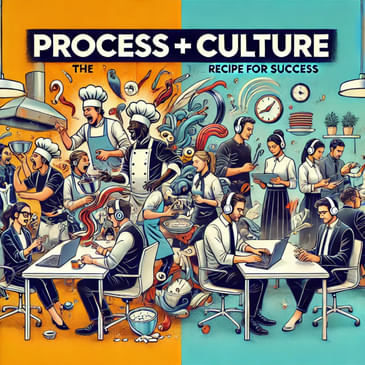
Process + Culture = Business Magic! 🌟
In our latest podcast episode, we tackle the great business balancing act: process versus culture. Ever tried launching a new project only for "too many cooks in the kitchen" to ruin it? Or wondered if a disruptor can mesh with a team of collaborators? (Spoiler: Sometimes yes, sometimes no.)
We share tales from trade shows, tips on building scalable processes, and why being upfront about your culture might just save you years of regret. Whether you're hiring, managing clients, or just trying to keep your team sane, this episode's for you.
Got stories of cultural mismatches or process breakthroughs? We’d love to hear! 👇
[00:00:18] Hello everyone, I'm Andy coming to you from the United Kingdom and welcome to the last month of the year.
[00:00:25] Hello Andy, I am your other host Scott coming to you from Toronto where it definitely feels like we are entering a new season. Winter is on its way.
[00:00:38] That's good. It's a beautiful time of year over there isn't it?
[00:00:41] At the moment, no.
[00:00:43] The transition maybe not so much, but when it comes, it comes. It's very nice.
[00:00:48] You know bright sunny snow covered winter day for sure. Today is not that day.
[00:00:55] No fair enough. Well today this is the Tea and Timbits podcast, Global Perspectives on Business Development to help you prosper.
[00:01:03] This month we are going to be talking about process and we will be opening that series I suppose.
[00:01:11] With the Importance of Process and Qualifying for a Culture Fit.
[00:01:17] But before we get into that topic, Scott, I understand you have a story for us.
[00:01:22] I do and I think I was reflecting on it or it sort of stood out in my mind when I was sort of observing the moment happen
[00:01:31] and thinking about the fact that we were doing this theme for December.
[00:01:39] As you know, I was at a trade show recently and I told a quick story last time about my delivery woes and my shipping.
[00:01:48] Well, it's still not resolved. We'll see what happens there. That's not my story.
[00:01:53] I'll just keep complaining about it until I get out.
[00:01:57] That might be a long complaint.
[00:01:59] Yeah. I was talking with another business associate business colleague at this event about trying to get things done.
[00:02:09] And he was lamenting that he had gotten this sort of, let's call it an influencer program for lack of a better sense.
[00:02:18] I mean, in the corporate space, they have a different word, call them champions or MVPs or what have you.
[00:02:25] And it was a really good idea and it sort of got a lot of enthusiasm internally.
[00:02:32] And it, you know, it launched to great fanfare by corporate standards, which means they send an email.
[00:02:40] And, and, and then it, it kind of took on this life of its own.
[00:02:50] It manifested into everybody wanting to, to sort of have a say in it and, and, and, and, you know, lend their influence to it and nothing happened.
[00:03:01] And it, and it never really gained any momentum.
[00:03:06] Um, and, and, and it was because there were too many cooks in the kitchen.
[00:03:10] There were too many people trying to, um, assert their, their opinion.
[00:03:15] And it really only takes one person to dissent in, in some of those scenarios to, um, to kind of kibosh it, especially when it's, and it's sort of a, um, a self initiated.
[00:03:30] Um, and endeavor when, when somebody is trying to sort of, uh, show some initiative and put in a, put together a new program package pro, you know, project idea, what have you.
[00:03:42] It's not really sort of a top down mandate.
[00:03:44] It's, it's one of those scenarios.
[00:03:46] Well then, then, you know, if you really can't get perfect alignment, it's very easy for those kinds of things to get derailed.
[00:03:53] So, you know, the, the, the comment was watch out for that.
[00:03:58] And, and, you know, he's managed to reign it all back in and sort of, it, it, it sort of died on the vine, which meant he was able to kind of go quietly and, and, and recover it, but do it, do it differently.
[00:04:12] Still with the right kind of communication and, and to get the internal support, but kind of with a smaller core group of maybe just, you know, one other person to, to lead it.
[00:04:23] Um, and then, and then one, it has a little bit more formality and official structure.
[00:04:28] Sure.
[00:04:29] Loop, loop more people in.
[00:04:30] Um, so I think we've all sort of recognized those moments and I'm, I'm not saying don't involve stakeholders and other, um, key contributors.
[00:04:40] Um, you know, but if you're trying to move something along, um, it does require, uh, some assertive leadership, a bit of process.
[00:04:49] And I think that kind of gets what we were going to talk to talk about today.
[00:04:51] It does.
[00:04:52] That was a, that was a good segue there.
[00:04:54] I quite like that.
[00:04:56] No, very good.
[00:04:57] Very good.
[00:04:58] So what is, what is your desired outcome from this discussion on the importance of process and qualifying for a culture fit?
[00:05:06] So I, I like the second part of sort of the title here, qualifying for the culture fit.
[00:05:14] Um, I am a believer that process is important.
[00:05:18] Um, but I, but I also feel that, um, if it's imposed, um, in the wrong environment, it won't help.
[00:05:31] And if the people in the posture and the character of some of those folks, um, and not even the individuals, but the, but the job function, the role, um, you know, if you need your, I think that's, you know, my mind, I'm thinking about business development in particular.
[00:05:46] So, and now I'm getting into the episode, but what, what I saw, I'll, I'll write it back into your question, which is what I hope people get out of it.
[00:05:52] And that is the culture fit part that, you know, we all, we all have heard the, the endorsement for process.
[00:05:59] Um, but I often think we forget to make sure that the process is engineered for the culture or that the, um, the, the, the staffing, um, of, um, the, the department is aligned with, um, with the process.
[00:06:20] So you, you hire into the culture that exists.
[00:06:23] So it's a very sensitive sort of part of finding process success.
[00:06:27] I think it's a, a very good desired outcome because I think it's something that people do forget.
[00:06:34] I mean, when you're doing the recruiting, um, or, you know, trying to add customers and, um, you know, business partners and so on, it's often focused very much on the, you know, on the functional, uh, capabilities.
[00:06:50] And, uh, you know, can this person do the job?
[00:06:52] Can this person, you know, um, do it in such a way that, uh, that is going to deliver the results that we want, uh, the same with the service partner.
[00:07:02] And is, you know, when it comes to customers, is this customer willing to spend the money that we want for the product?
[00:07:07] Good.
[00:07:07] Then that's fine.
[00:07:09] Right.
[00:07:09] But neglecting the cultural fit actually is going to create a lot more problems than, uh, than if you did to take the time to consider it and maybe take out a, uh, an otherwise well-qualified candidate or business partner or customer, uh, which is always a hard decision.
[00:07:27] And that's probably why a lot of people don't do it.
[00:07:30] Right.
[00:07:30] Um, but the impact of not doing it is, uh, is often quite great.
[00:07:34] I mean, um, I, I've definitely seen it, seen it happen, um, where you get, you know, a new, new member on the team and, um, yeah, uh, it can result in some internal conflict, um, and some customer dissatisfaction has not been taken into consideration.
[00:07:52] Yeah.
[00:07:53] And that's, that's, you know, we're saying the same thing here.
[00:07:55] I think, um, you have, there's, you know, um, there's, there's one responsibility, which is when you're sort of resourcing, building it, your team, maintaining it.
[00:08:07] When there's turnover, you cannot hire just for skill and experience.
[00:08:15] Right.
[00:08:16] And you also cannot hire just for enthusiasm and culture and personality.
[00:08:24] Right.
[00:08:24] And you cannot even just hire for sort of what you feel is a good blend of both of those things.
[00:08:29] Your filter needs to be your process.
[00:08:34] Yes, completely.
[00:08:35] What do I, what do I got internally?
[00:08:38] And, and, and there's also, so we're, we're talking about an internal resourcing thing, but I also like for us, this applies every day when we're dealing with clients.
[00:08:50] Yeah, exactly.
[00:08:50] Exactly.
[00:08:51] For customers, for service partners, everything.
[00:08:54] Yeah.
[00:09:22] Right.
[00:09:24] It's both an internal thing and it's an external, um, qualification thing.
[00:09:27] Part of, part of, it's a lot easier in a smaller business to sort of pick and choose for, you know, client cultural fit.
[00:09:34] Um, but I think as you're scaling, you need that even more.
[00:09:37] If you, if you, if you sign up for, if you sign up for, if you sign up for, if you sign up for, if you sign up for, and listen, like every, every growing company is, is guilty of just, you know, signing up another client because, you know, they need to add the revenue or maybe next step to, to help them accelerate, um, their, their growth.
[00:09:54] And sometimes it is, but sometimes it's, it's, it's the one you're going to spend years kind of, uh, you know, disappointed that you took it on.
[00:10:01] because now you're committed.
[00:10:04] Coming back to the point here is
[00:10:07] make sure that you are communicating
[00:10:10] and honest with both that process that you have
[00:10:16] and the culture that's in place already
[00:10:20] that surrounds that, that makes that work
[00:10:23] or is holding that back.
[00:10:25] I mean, you might be trying to evolve here, right?
[00:10:28] But you can't be the only one to make the decision
[00:10:33] is what I'm saying.
[00:10:34] You're hiring.
[00:10:35] It's not about going,
[00:10:36] well, if I just ask the right questions
[00:10:37] or say the right things
[00:10:38] or talk to this person long enough,
[00:10:39] it'll come to me.
[00:10:41] It will.
[00:10:42] But you need to make sure you're doing your darndest
[00:10:44] to tell the other party as much as you know
[00:10:47] about how your systems function,
[00:10:50] how your work gets done,
[00:10:52] the culture that surrounds that
[00:10:55] so that you're transparent
[00:10:57] and they know what they're walking into,
[00:10:59] whether that's a client or a person.
[00:11:04] So what would you say?
[00:11:06] I mean, you said this was the first step
[00:11:08] of your sales process is this qualification.
[00:11:12] How did you go about defining what your culture was?
[00:11:18] Right.
[00:11:19] So when you ask that question,
[00:11:20] it's sort of sometimes I think might be assumed
[00:11:23] that we started by defining a culture we wanted,
[00:11:26] then put things in place in order to achieve that culture.
[00:11:29] That's not at all what happened.
[00:11:32] It is the natural evolution of the culture
[00:11:35] and it's being able to look at it and go,
[00:11:38] okay, wait a minute.
[00:11:38] That is the culture.
[00:11:40] Like, you know, we're an agency
[00:11:43] and the classic stereotypical thing,
[00:11:46] at least in North America,
[00:11:48] is, you know, thirsty Thursdays,
[00:11:50] foosball tables.
[00:11:51] Like, it's a kind of a fun,
[00:11:53] high energetic environment
[00:11:55] and everybody's, you know,
[00:11:59] just super excited to, you know,
[00:12:01] be having fun with all their colleagues.
[00:12:03] There's a lot of good, serious work
[00:12:04] that gets done in agencies
[00:12:06] with that kind of culture too.
[00:12:07] It's very creative.
[00:12:09] But sometimes clients even kind of expect that vibe
[00:12:12] when they come in for a meeting or a conversation.
[00:12:15] And that's not at all the way
[00:12:17] that you would discover the culture to be with us.
[00:12:22] It is a heads down, headphones on.
[00:12:26] If you're collaborating, you're doing it over chat,
[00:12:29] you know, it is just everybody geeks out
[00:12:34] on the problems that they're solving,
[00:12:36] the work that they're getting done
[00:12:36] and the satisfaction of accomplishing that.
[00:12:40] You know, and that's a very...
[00:12:42] And so some people, when hiring,
[00:12:44] have walked into our office and been like,
[00:12:48] it's really quiet in here.
[00:12:49] And I'm like, yeah, that's right.
[00:12:52] Everybody's smiling and enjoying their work,
[00:12:54] but, you know, you're kind of doing it
[00:12:56] in their own zone
[00:12:56] and they're still communicating,
[00:12:58] but you just don't hear it.
[00:13:00] And if you're looking for an environment
[00:13:01] that is a contrast to this,
[00:13:05] then, you know, you'll find it.
[00:13:08] Keep looking.
[00:13:09] Yeah, that's right.
[00:13:10] And this isn't the place for you,
[00:13:11] if that's the case, isn't it?
[00:13:12] You know, and that's the good thing,
[00:13:14] is that because it's very clear
[00:13:17] and everybody there understands it,
[00:13:19] you know, maybe not necessarily
[00:13:23] by looking at a document and going,
[00:13:25] oh, this is how I need to behave.
[00:13:26] It's just something that is natural
[00:13:28] when you get that good
[00:13:30] and right group of people together
[00:13:32] that they just work very well
[00:13:35] and that becomes part of that culture.
[00:13:36] That is the life that you have.
[00:13:39] And I'll say, also,
[00:13:40] I think it's worth making the point
[00:13:42] that like both of these things
[00:13:43] can change and shift over time.
[00:13:47] You'll find that, you know,
[00:13:50] that culture process that's in place
[00:13:52] is actually not very efficient
[00:13:54] or effective to achieve business outcomes.
[00:13:57] And you might need to change
[00:13:59] one or both of those things.
[00:14:02] You'll also find that the individuals,
[00:14:05] both on the client side,
[00:14:06] both internally,
[00:14:09] will shift over time.
[00:14:10] Even the individuals,
[00:14:12] it's not that the makeup
[00:14:13] of the team has changed
[00:14:16] or the dynamic of the client has changed.
[00:14:19] I mean, we see this often
[00:14:21] as economic scenarios shift
[00:14:25] and clients get given different mandates
[00:14:28] and then all of a sudden,
[00:14:29] the same person you've been jiving with
[00:14:31] really well on the other side of the table
[00:14:33] is got a different posture
[00:14:35] and expecting different things
[00:14:37] because they've been told
[00:14:38] that for their business,
[00:14:39] this is, you know,
[00:14:40] a new normal.
[00:14:44] And there needs,
[00:14:46] so there does need to be some flexibility
[00:14:49] when you look at applying process.
[00:14:52] And I think a good process
[00:14:54] has some baked in element
[00:14:58] to accommodate
[00:14:59] and be resilient
[00:15:00] for being able to accommodate
[00:15:04] a certain amount of flexibility.
[00:15:06] There's a threshold there, obviously.
[00:15:09] But I think a good process
[00:15:11] is clearly defined
[00:15:11] and has sort of a structure to it.
[00:15:13] But part of that structure is flexibility.
[00:15:16] Yeah, definitely.
[00:15:17] When you,
[00:15:19] in your own business
[00:15:20] and in, you know,
[00:15:21] companies that you work with,
[00:15:23] do you see a lot of
[00:15:27] team involvement
[00:15:28] in the decision making?
[00:15:33] Yeah.
[00:15:33] I mean, our whole entire delivery approach,
[00:15:40] our project structure
[00:15:43] is, requires that.
[00:15:46] That it, you know,
[00:15:48] there are certain,
[00:15:49] there's work that needs to get done.
[00:15:52] There are, you know,
[00:15:56] there are products
[00:15:56] that need to get built
[00:15:58] and services that need to get delivered
[00:15:59] that have a finite, clear definition.
[00:16:03] And somebody needs to say,
[00:16:06] yep or nope.
[00:16:08] But feeding into
[00:16:11] that requires
[00:16:12] a great degree of collaboration,
[00:16:16] transparency, communication.
[00:16:19] When it comes to,
[00:16:21] I'm asking you all these questions
[00:16:23] rather than making statements,
[00:16:25] but it's fine.
[00:16:27] I mean,
[00:16:28] when you're talking about
[00:16:29] a sales team culture,
[00:16:30] you can often have,
[00:16:31] you know,
[00:16:31] some quite,
[00:16:33] I suppose,
[00:16:35] cutthroat sales people,
[00:16:36] you know,
[00:16:36] who are quite,
[00:16:37] you know,
[00:16:37] forward,
[00:16:38] very loud
[00:16:41] and boisterous
[00:16:43] and determined
[00:16:44] and very focused
[00:16:45] on what they're doing
[00:16:45] and the way they're doing it.
[00:16:47] That can work well
[00:16:48] individually,
[00:16:50] but it can disrupt
[00:16:51] a team culture.
[00:16:54] How do you propose
[00:16:56] that companies
[00:16:57] who need that type of person
[00:16:59] in their sales team
[00:17:00] but maybe feel
[00:17:01] that doesn't fit
[00:17:02] in a culture,
[00:17:03] how would you propose
[00:17:04] that the companies
[00:17:05] try and balance that
[00:17:06] and help to integrate
[00:17:09] those two different cultures,
[00:17:12] I suppose,
[00:17:13] into a business?
[00:17:14] Is there something
[00:17:15] behind that question?
[00:17:15] Like,
[00:17:16] have you seen that happen?
[00:17:17] Have you got that experience?
[00:17:18] Yeah,
[00:17:18] I mean,
[00:17:19] I'm often that person
[00:17:21] as well.
[00:17:21] So, you know,
[00:17:23] so it is something
[00:17:24] I personally
[00:17:25] have to work with
[00:17:26] because I work
[00:17:27] with so many different companies
[00:17:28] with so many different cultures.
[00:17:31] It is often the case
[00:17:34] that sometimes
[00:17:35] these companies
[00:17:35] have a disconnect
[00:17:36] between the sales team
[00:17:37] and the rest of the organization,
[00:17:38] sometimes within
[00:17:39] the team themselves
[00:17:42] and then often,
[00:17:43] you know,
[00:17:43] I'm coming in
[00:17:44] with the purpose
[00:17:44] of shaking things up
[00:17:45] and realigning things
[00:17:46] or changing things
[00:17:47] and so I have to be quite,
[00:17:49] you know,
[00:17:50] not necessarily a fit
[00:17:51] with the current culture
[00:17:54] and help to drive that change
[00:17:56] which can be really challenging
[00:17:57] which is why
[00:17:58] I'm not trying to make
[00:17:58] any bold statements here
[00:18:00] because I think
[00:18:00] all cultures work
[00:18:02] but you need to be
[00:18:04] very clear
[00:18:05] on what that culture is
[00:18:06] and not try and go,
[00:18:07] oh,
[00:18:07] well,
[00:18:07] a little bit of this
[00:18:08] and a little bit of that,
[00:18:09] that will be fine.
[00:18:10] It isn't
[00:18:11] and it doesn't work.
[00:18:12] So,
[00:18:12] if you do need
[00:18:13] these different personalities
[00:18:14] within your,
[00:18:16] you know,
[00:18:17] corporate culture
[00:18:18] including from customers,
[00:18:20] service partners
[00:18:21] as well as employees
[00:18:23] and people on the sales team,
[00:18:24] it is very,
[00:18:26] very important
[00:18:27] that it is made aware of
[00:18:29] and not just ignored
[00:18:30] and that there are activities
[00:18:31] put in place
[00:18:32] to bridge those gaps
[00:18:34] such as,
[00:18:35] you know,
[00:18:37] kick off,
[00:18:38] you know,
[00:18:39] team meetings
[00:18:40] and events
[00:18:40] and quarterly
[00:18:41] get-togethers
[00:18:42] and stuff
[00:18:42] where everyone
[00:18:43] comes together
[00:18:43] in a less professional
[00:18:45] environment
[00:18:45] so that people
[00:18:46] get to know
[00:18:47] the person behind
[00:18:48] the business person
[00:18:50] that they're interacting
[00:18:51] with on a daily basis
[00:18:52] and I think that
[00:18:53] can also be an important
[00:18:54] part of the culture
[00:18:55] and again,
[00:18:56] you know,
[00:18:57] there's nothing wrong
[00:18:57] with doing those type
[00:18:58] of events
[00:18:58] with customers as well
[00:18:59] and service partners.
[00:19:01] Yeah,
[00:19:02] and I would suggest
[00:19:04] there's probably
[00:19:05] a difference
[00:19:05] between
[00:19:06] sort of
[00:19:07] building out
[00:19:08] your team
[00:19:09] and hiring
[00:19:11] you
[00:19:11] to
[00:19:13] shake things up
[00:19:14] and so sometimes,
[00:19:16] you know,
[00:19:16] you need a disruptor
[00:19:17] in order to
[00:19:20] perhaps more rapidly
[00:19:23] change
[00:19:26] because I think
[00:19:26] it's a bit of a
[00:19:28] there's a
[00:19:30] I was going to say
[00:19:31] I don't know
[00:19:32] that the question
[00:19:33] itself
[00:19:33] is as
[00:19:35] obvious
[00:19:36] as
[00:19:36] No,
[00:19:37] maybe not.
[00:19:37] You know,
[00:19:38] as we've been saying here
[00:19:39] and
[00:19:40] because I don't think
[00:19:41] that you
[00:19:42] that you need
[00:19:43] that kind of
[00:19:44] boisterous sales
[00:19:45] person
[00:19:47] doing their
[00:19:48] doing their thing
[00:19:49] if it's disrupting
[00:19:51] the rest of the
[00:19:51] organization.
[00:19:52] Correct.
[00:19:53] If it doesn't fit
[00:19:54] then it's not
[00:19:54] like,
[00:19:55] you know,
[00:19:56] go for
[00:19:57] you can
[00:19:57] you can find
[00:19:59] people whose
[00:20:00] approach
[00:20:01] posture
[00:20:02] character
[00:20:02] is
[00:20:03] a contrast
[00:20:04] to that
[00:20:05] who are
[00:20:06] equally as
[00:20:07] effective
[00:20:07] at delivering
[00:20:08] sales results.
[00:20:10] So
[00:20:10] that might
[00:20:12] work for that
[00:20:12] person
[00:20:13] and it might
[00:20:14] work for you
[00:20:15] and your
[00:20:15] business
[00:20:15] but if it's
[00:20:16] causing other
[00:20:16] kind of turmoil
[00:20:17] and
[00:20:18] friction
[00:20:21] it's not a
[00:20:22] culture fit
[00:20:22] for your process.
[00:20:23] No,
[00:20:23] that's right.
[00:20:24] That's right.
[00:20:26] There was a
[00:20:27] company and I'm
[00:20:27] trying to,
[00:20:28] I've been trying
[00:20:28] the whole time
[00:20:29] I've been talking
[00:20:29] to remember the
[00:20:30] name but I
[00:20:31] really can't
[00:20:31] but they
[00:20:31] quite famously
[00:20:32] they prioritized
[00:20:33] their cultural
[00:20:34] fit in the
[00:20:35] business so
[00:20:36] so much
[00:20:38] that during
[00:20:39] the training
[00:20:39] phase,
[00:20:40] you know,
[00:20:40] when they get
[00:20:41] someone in
[00:20:41] they've gone
[00:20:41] through the
[00:20:41] hiring process
[00:20:42] they felt
[00:20:43] that they're
[00:20:43] the right
[00:20:43] people.
[00:20:44] If they
[00:20:44] then feel
[00:20:45] during that
[00:20:46] training
[00:20:46] phase that
[00:20:47] they're not
[00:20:47] a cultural
[00:20:48] fit with the
[00:20:49] rest of the
[00:20:50] organization,
[00:20:50] they'll actually
[00:20:51] buy them out
[00:20:51] of their
[00:20:52] contract
[00:20:53] because they'd
[00:20:54] rather have
[00:20:54] someone who
[00:20:56] fits within
[00:20:56] the organization
[00:20:57] than potentially
[00:20:58] damage that by
[00:20:59] having the
[00:20:59] wrong person
[00:20:59] join.
[00:21:00] I can't remember
[00:21:01] the name of the
[00:21:01] company.
[00:21:05] No,
[00:21:05] no,
[00:21:05] it's a real
[00:21:06] company.
[00:21:06] It's a real
[00:21:06] company.
[00:21:07] Yeah,
[00:21:08] I think they're
[00:21:08] offering like,
[00:21:09] you know,
[00:21:10] candidates at all
[00:21:10] stages,
[00:21:11] you know,
[00:21:12] a couple of
[00:21:12] thousand dollars
[00:21:13] and stuff to
[00:21:13] leave the
[00:21:14] process.
[00:21:15] So,
[00:21:15] yeah,
[00:21:16] interesting.
[00:21:17] There you
[00:21:18] go.
[00:21:20] Go on then.
[00:21:21] Okay,
[00:21:22] I was going to
[00:21:23] have another
[00:21:23] point,
[00:21:24] but I've just
[00:21:25] seen how long
[00:21:26] this episode
[00:21:26] has become.
[00:21:27] So,
[00:21:28] I think we
[00:21:30] have achieved
[00:21:31] your goal
[00:21:32] of making
[00:21:33] it very
[00:21:33] clear that
[00:21:33] the culture
[00:21:34] is an
[00:21:35] important
[00:21:35] part.
[00:21:36] What are
[00:21:37] your thoughts
[00:21:37] on that?
[00:21:39] Yeah,
[00:21:39] I hope
[00:21:41] so.
[00:21:42] It really
[00:21:43] is sort
[00:21:44] of about
[00:21:45] both needing
[00:21:46] a good,
[00:21:46] strong process
[00:21:47] and having
[00:21:47] the right
[00:21:48] people to
[00:22:00] get in
[00:22:01] touch with
[00:22:01] us at
[00:22:02] teantinbits.com
[00:22:03] where you'll
[00:22:04] find many
[00:22:04] ways to
[00:22:05] stay in
[00:22:05] touch and
[00:22:06] to subscribe
[00:22:07] and listen
[00:22:07] and watch
[00:22:08] us in the
[00:22:09] future.
[00:22:10] But for
[00:22:10] now,
[00:22:11] thank you
[00:22:11] very much,
[00:22:12] Scott.
[00:22:12] Thanks,
[00:22:13] Andy.
[00:22:13] Thanks,
[00:22:13] everybody.