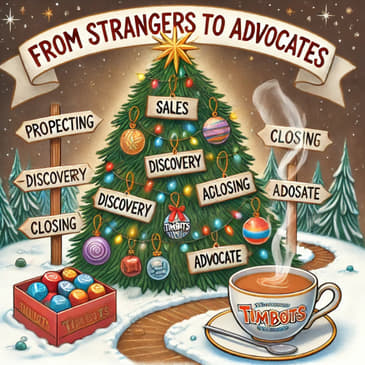
🎄🎄🎄🎄🎄 Ready to level up your sales game just in time for the holidays? In our latest Tea & Timbits episode, we dive into what makes a sales process truly great. Hint: it's not about overcomplicating things or skipping steps—it’s about creating a clear, flexible journey that turns strangers into advocates. 💡
We also tackle the dreaded RFP, share lessons from broken processes, and discuss why sometimes stepping away is the best move. Whether you're flying solo or steering a sales team, this episode is your gift of insights for the season! 🎁
Tune in now and let us know—what’s your secret ingredient for a winning sales process? ☕🍩
#SalesProcess #BusinessDevelopment #TeaAndTimbits #Podcast #HolidayWisdom
[00:00:20] Ho Ho Ho Ho It's only a week until I'm getting excited now. I've put on my Wham t-shirt and it will probably be peeled off me towards the end of the season. I'm Andy and I'm coming to you from a festive United Kingdom.
[00:00:39] Good to see you as always Andy. And hello everybody. I am your other host Scott coming to you from an equally festive Toronto.
[00:00:48] Andy Baqone Lovely. Has the snow started to fall?
[00:00:51] Andy Baqone Yes. My kids lament that there isn't enough on the ground, but it stayed warm pretty well through the fall and then it kind of switched.
[00:01:04] Andy Baqone Right at the end of November, December.
[00:01:07] Andy Baqone I love it. Well, this is the Tea and Timbits podcast where we talk about global perspectives on business development to help you prosper.
[00:01:16] Andy Baqone I almost forgot what we did there. I'm so focused on Christmas now that I can't remember anything.
[00:01:23] Andy Baqone Have you done your Christmas shopping? Have you got it all done?
[00:01:25] Andy Baqone I am very good at my Christmas shopping. I buy Christmas presents throughout the year and then I just have a place that I keep them.
[00:01:32] Andy Baqone At Christmas I get surprised as well about all of the great things that I've got for other people.
[00:01:38] Andy Baqone I look forward to my package arriving.
[00:01:43] Andy Baqone Carry on.
[00:01:46] Andy Baqone Yeah, this week we are going to be talking about what makes a good sales process because this month we are talking about process and we don't want to make it too boring, which is why we briefly talked about risk last week.
[00:02:03] Andy Baqone Scott got very unhappy with me, but we will continue this week with a much more positive and happy topic.
[00:02:10] Andy Baqone But before we get into that, Scott, do you have a story for us?
[00:02:14] Andy Baqone You're just trying to see what kind of reaction you get from Andy.
[00:02:18] Andy Baqone I know.
[00:02:20] Andy Baqone I'm just pushing. It's like a season of goodwill, so I'm trying to put a little bit of badwill in there.
[00:02:26] Andy Baqone Trying to make sure you're
[00:02:27] Andy Baqone See how far I can push that goodwill.
[00:02:29] Andy Baqone It doesn't stay too high?
[00:02:32] Andy Baqone All right, well, Andy, if I'm doing a solo episode next week, everybody will know why.
[00:02:39] Andy Baqone The story I was going to share was a process story.
[00:02:44] Andy Baqone And we had a project where we, for a client we've had for quite some time.
[00:02:51] Andy Baqone And throughout the year we'll do different initiatives and new engagements and
[00:02:57] new features and other projects and whatnot.
[00:02:59] Andy Baqone And we'll always sort of reflect on what worked
[00:03:03] well and what do we need to shift and change for next time.
[00:03:07] Andy Baqone And recently, before kicking off another project, we put a lot of work into,
[00:03:15] Andy Baqone You know what, if we run it this way, if we get the right people involved at this step,
[00:03:18] Andy Baqone If we do it in this order, if our team gets involved this way at this point,
[00:03:24] Andy Baqone This is how we think it's all going to go better.
[00:03:28] Andy Baqone And wouldn't you know it, the very, very first step,
[00:03:34] Andy Baqone The process was broken.
[00:03:37] Andy Baqone And there was, and it wasn't like, oh, we're really sorry.
[00:03:43] Andy Baqone We know this isn't at all what we agreed, but I had to, you know, I had to do it
[00:03:49] for internal reasons or for this, that, or the thing. And, and, you know, and I, and I appreciate
[00:03:56] that, you know, this, this is a deviation and I'm willing to do X, Y, Z to get us back on track.
[00:04:01] Andy Baqone It was just, well, no, now we are where we are. We're going to keep
[00:04:05] like steamrolling forward. And then I was left in a scenario of trying to, to pick up the pieces
[00:04:16] and trying to say, well, what do we do now? And we're back where we tried not to go from last time.
[00:04:24] Andy Baqone And the, so I was really proud of having done all this initial alignment work to say,
[00:04:32] and, and, and there was great enthusiasm for what we had agreed upon.
[00:04:37] And it felt good in that moment. And I was like, awesome. Oh, like we've done this. We've had some
[00:04:42] good conversations. We are going to, we're going to, we're going to be able to do this with so much
[00:04:47] more efficiency, enjoyment and, and, um, and impact. Awesome. All right, off we go.
[00:04:54] Andy Baqone And then, and then it fell apart and it was like, so, and for the team internally,
[00:04:58] it was so like demoralizing. Uh, it was such a, you know, um, um, the, the, the, the air came out of
[00:05:06] the balloon, so to speak. Um, and I was reflecting on like, well, what? Cause then I'm sending emails
[00:05:12] going like, well, now we are here, we're going to have to do this. And could I get you to get on a call?
[00:05:16] Can we talk? And like nothing internally for myself, what I've, um, um, decided, uh, what I want
[00:05:28] to try not to forget for next time is you have to also at the beginning, when you're establishing that
[00:05:34] alignment, talk about the negative outcome. Okay, great. We are aligned on all this, but now let's
[00:05:43] talk about what happens if this breaks down. There needs to be that initial upfront agreement on
[00:05:51] not just what the process should be, but what are we going to do if we don't each hold up our end of
[00:05:57] the bargain or follow this, this process? Like a risk analysis. Yeah. That's the word that was
[00:06:02] coming through my mind. If you're watching this video, you can see how smug Andy's face is right now.
[00:06:13] If you're not, let me tell you, he's just, uh, feeling very proud of himself there.
[00:06:18] Anyway, that's my story. I'm done now. Thank you for the story Scott really appreciate it. And
[00:06:24] the opportunity to, um, tease you once more in this episode, I will not push or extend this, uh,
[00:06:31] goodwill to, to, to, too far. Um, let's vote here. I will, um, the, uh, what is a sales process?
[00:06:41] We are talking this week about, you know, the, uh, what makes a good sales process, but
[00:06:46] what is a sales process? Yeah. And I thought that it was sort of an obvious part of business development,
[00:06:56] even though we existed for so long without this. Um, and then when I discovered it and have been
[00:07:02] sort of following it and implementing it within our own organization, it just feels so normal and
[00:07:08] natural, but again, sort of interacting with clients and other business partners. And you see that,
[00:07:14] you know, a lot, a lot of times people are just reacting in the moment, doing what they think is
[00:07:21] appropriate for each particular opportunity and each particular client, and they're letting the client
[00:07:25] lead and, and drive things forward. Just hoping that, you know, less friction, more, you know,
[00:07:33] friendliness and accommodation is going to help them win the deal. So that's what it isn't.
[00:07:42] Let me define what it is by telling you what it isn't. Um, but it is a very clearly articulated set of
[00:07:49] steps, um, that you go through in your sales, um, conversations in your sales process to get from,
[00:07:57] uh, you know, uh, stranger to, to, to advocate, um, uh, which is what they become after they become a
[00:08:06] delighted customer. Um, and, um, and there, there, there can be, I don't want to overcomplicate it,
[00:08:15] which is where sort of the hesitation and, and, and my train of thought at the moment is coming from,
[00:08:19] but we have a sales process for when it is an identified opportunity, which means somebody,
[00:08:25] we've qualified them. They need something and, um, and they're ready to spend money. Basically,
[00:08:32] they have a problem and they have a motivation to solve the problem. Sometimes, sometimes people,
[00:08:38] you find people who have a problem, but they don't really, you know, want to address it. You start
[00:08:42] trying to convince them that's not an opportunity in our world. Um, there's a whole other part of
[00:08:48] sales, which is lead generation, demand generation, getting, getting that initial top of funnel
[00:08:54] interest. We do not have a process for that. Um, I have a draft one. I have a sketch of what it
[00:09:00] could be. I have ideas in my mind, um, for a very long time, the activities that we kind of
[00:09:06] were executing from a demand generation where we're working and we really just needed the,
[00:09:12] the opportunity, um, management side, we've got a really well, um, constructed opportunity
[00:09:17] management process. We, we do need, um, something more formal on the,
[00:09:22] on the lead management lead, um, um, demand generation, uh, front. So the reason I sort
[00:09:30] of had injected that in into it is you can have a collection of processes to cover your,
[00:09:37] your business development department or, um, or, or life cycle. Um, and, and, or, or it can be
[00:09:45] sort of one overarching one. So that's what a, what a process is, um, to me. And one final comment is you
[00:09:52] can show it, you can bring up a desk and you can, you can, you can articulate it to your prospect and
[00:10:00] you need to. So yeah. Yeah. Involved. You asked me, I could show it to you. Yep. Yeah. No, that's the
[00:10:07] absolute key. I mean, as you, as you said, it's not just about closing deals. It's about creating that
[00:10:12] sort of predictable pipeline, um, uh, that delivers value to the customer. And that value can be to
[00:10:19] realize that you're not good for working with each other. Um, or that it's not the right opportunity
[00:10:23] or that they're not ready or, um, you know, or that you're not ready, but yeah, exactly that.
[00:10:29] That is a good sales process. But, um, if we go down, yeah, go on.
[00:10:34] All right. Do you want to finish your thought there? Nope. What, what are the, so I mentioned
[00:10:41] that like we have one clearly defined for managing an opportunity and working on one for lead generation.
[00:10:48] What have you seen? Have you seen it exist in one of those scenarios, not the other? Have you seen
[00:10:52] one process to rule them all? Um, I rarely see. I mean, I, I tend to find myself going into companies
[00:11:02] who lack a sales process altogether. Um, you know, it, there's, there's no structure for prospecting,
[00:11:09] no, no structure for discovery work. There's no structure for, um, you know, what happens when
[00:11:15] a customer says they want to do stuff. Yeah. There'll be processes, internal processes that are
[00:11:20] defined by what other departments need from you, you know, fill in a credit application for,
[00:11:26] you know, fill in a new customer thing, register that you picked up the phone to them in the CRM,
[00:11:31] which often doesn't happen of course. Um, uh, but that's really as far as it goes,
[00:11:36] it's really sort of driven by what the internal processes are. Um, if they exist in the other
[00:11:43] departments and they have needs, then that is what sort of tends to drive the activities.
[00:11:47] And that's really, really wrong. I mean, the, those things should be featured in your process,
[00:11:52] but very clearly defined at this point, we will need to go through a credit application. We will need to,
[00:11:57] you know, do this and do that. But the sales process should not be driven by,
[00:12:05] you know, the internal steps that you need to make. It should be a journey that you're taking
[00:12:10] someone on from, as you said, a stranger to advocate and, you know, somebody from a prospect
[00:12:16] to a customer. Um, and the steps that you take on that will vary depending on your business,
[00:12:23] the type of product you're selling, the size of business, the types of customers you're working
[00:12:26] with, you know, whether it's a service, whether it's a product, but you should still have a process.
[00:12:32] It should be written down. It should be defined and it should be followed and it should be documented.
[00:12:37] So, um, I'm going to make the bold assumption here that not everybody that, um, is listening is in a
[00:12:44] position to, uh, implement, uh, or, or create that process. And if it doesn't exist, um,
[00:12:55] is it something that an individual can, can do, or does it have to come from, um, the, the, the,
[00:13:03] the business? No, that, that is a very, very good question because I have seen a couple of companies
[00:13:09] that I've worked with where there are star salespeople in the teams and they are doing really
[00:13:15] well because of the fact they have put a process in place where there is none for the organization
[00:13:22] and they follow that process. And it doesn't have to be complicated. I mean, it's, you know,
[00:13:27] it starts with prospecting and discovery work and, you know, next steps sort of, I don't know,
[00:13:33] presenting a solution, handling objections and closing the deal. You know, it doesn't have to
[00:13:37] have really, really complicated steps. Yes. Each part of that will have steps within it,
[00:13:41] but understanding that framework, understanding that journey you're taking a customer on
[00:13:45] and the things that you need to do to get the customer into that journey and help them along
[00:13:50] that journey and manage all of your internal steps. You can do that yourself. You know, you can put that
[00:13:56] in yourself and create that, um, and manage it within your own CRM systems, manage it within,
[00:14:01] you know, if you have a CRM system, um, and just create what you need in order to be successful.
[00:14:09] So as a leader of a sales team, you should be putting this thing in place.
[00:14:14] A hundred percent. And I, and I, I sort of have my, the same answer to the, to the question that
[00:14:18] I posed, which is, yeah, if you're in an organization, they, this is, this is missing,
[00:14:22] build it for yourself, build it for yourself and start following it for yourself. And then your
[00:14:28] teammates, your manager will see that, you know, and they, you know, I'm going to, I'm willing to
[00:14:33] bet they won't tell you to stop. And it will probably evolve into something that the whole
[00:14:38] organization, uh, it may not look the same, but it will be a seed. Um, second, second question. Um,
[00:14:47] and this is based on my own experience, uh, and the way that we have to operate. So sometimes we are
[00:14:52] executing our own sales process because they are, you know, it's a, it's a lead that has come into us.
[00:14:58] And other times we are selling through our channel partner. So the lead is theirs and it's their
[00:15:05] opportunity. And we become a subcontractor to deliver the implementation service.
[00:15:10] We, what do we, what, what is your advice to us about our sales process in that scenario?
[00:15:18] Well, it's a, it's a good question, but it's actually leading straight into a point that I
[00:15:23] wanted to make is that, you know, we were talking, we, yeah, we should do a podcast.
[00:15:30] We, we mentioned just now that it should be, you know, clear and simple when you have a sales
[00:15:37] process. And, uh, and part of the reason for that is that it's flexible and, um, that, you know,
[00:15:44] whilst you, you know, you have a structure that is kind of essential, um, for what happens,
[00:15:49] the process must allow flexibility and adaptability to, you know, unique customer
[00:15:54] circumstances or unique customer needs. And, um, you know, that's, that's what I was going to say.
[00:16:00] I mean, one of the biggest mistakes is, uh, over-complicating the process, um, and trying to
[00:16:05] do a one size fits all approach and skipping steps. Yeah. Don't skip the steps, you know,
[00:16:11] even if you have to adapt it, make sure that the steps are still there and that you're still taking
[00:16:15] on that journey, but that you've adapted it appropriately for that, the circumstances that
[00:16:19] you find yourself in. What I like about sort of coming back to like tying this all together to where
[00:16:25] we've gotten in the conversation so far is if you have it formalized and something you can show,
[00:16:30] there are defined steps. And to your point, when you're skipping steps, it's not because you've
[00:16:35] thrown process out the window. It's because you've gone, okay, wait a minute, we don't need this
[00:16:40] step anymore. So by the way, we're over here now in my process, you're doing your thing. I'm doing
[00:16:44] my thing. So in, in that kind of, um, now, now, okay. So now we're blending into another scenario
[00:16:51] that's in the back of my mind, which is an RFP process. So it's where there's a procurement
[00:16:56] person on the other side, whose job it is to, to establish this process on behalf of the buyer.
[00:17:02] And, and you have no choice, but to engage in that process and follow it. If you are an interested
[00:17:11] proponent, if you want to submit a bid. Um, so I'm, I'm curious what your thoughts are. Like,
[00:17:17] is it just, just again, be, be flexible and be adaptable in the same, in the same way in those,
[00:17:24] in those scenarios. I mean, it comes back to the last episode that we touched on, uh, with the risk
[00:17:29] analysis, because you need to understand if stepping away from your sales process and, um,
[00:17:36] especially the elements of it, which, you know, because essentially it should be,
[00:17:41] most of the steps should be customer focused. So if you're stepping away from that and you're
[00:17:46] reducing the amount of value and the amount of support that you're delivering to your customers,
[00:17:52] then are you still really delivering your product or the right product or a product that is actually
[00:17:57] going to deliver what the customer's after. And if you are able to adapt your sales process and still
[00:18:03] deliver excellence to the customers, then fine. Then you can adapt and accept the RFP or the RFQ process.
[00:18:11] But the best thing to do is sometimes step away from those situations. Uh, if you feel that you can no
[00:18:18] longer, uh, deliver the quality that is your business, it's hard sometimes because you get very excited about
[00:18:24] it. But the reality is even if you win that project, even if you win that sale, you haven't really won
[00:18:32] because you are setting yourself up for a lot of complications and a lot of challenges because you
[00:18:37] have stepped out of your sales process and you are unable to deliver what the customer really wants.
[00:18:43] So tell me what you think about whether this is, um, appropriate. I've, I've been working on a couple of
[00:18:49] RFP responses lately. Um, it's probably the first couple that I've done in a couple of years. Like
[00:18:54] we, we take, we generally don't respond to them. We will, if we're invited. Um, and somebody says,
[00:19:00] we'd really like to see your name on the list of responses. Um, that's a bit different and that's
[00:19:05] kind of my qualification to even consider it. So that does, that has happened, um, a couple of times,
[00:19:09] um, very recently. Um, I am absolutely playing the game. I am absolutely with the submission,
[00:19:18] trying to get past the first gate. I'm trying to put something in that goes, you know what,
[00:19:24] like you've got this, but as soon as you get into the short list, you get the conversation.
[00:19:32] And, and so if you're willing to put it in all the work, cause it's a ton of work to get to that point,
[00:19:37] then you still, there's no, no commitments. And you get to say, by the way, thank you for the fact
[00:19:42] that we tell me if you like this or not, by the way, thank you for the fact that we've been able to
[00:19:46] get to this point. Um, you know, it's been really interesting to get all your information and put
[00:19:51] together a thoughtful response. I want to let you know that we also have a sales process. You've
[00:19:56] got a procurement process. We've got an evaluation process to make sure that we're going to be enabled
[00:20:00] for success. So if you want to advance us further, we are going to need you to do a few of the other
[00:20:07] steps that we need in order to achieve success. If that's not going to suit you, it is not worth going
[00:20:13] much further. So you have to be ready to, to disqualify yourself after you've gotten through
[00:20:19] the first gate, but you don't get a chance to even put that forward. And then a couple of times that
[00:20:24] I've tried it, the, the other, um, party has been like impressed. They've been like,
[00:20:31] Yeah, absolutely. Cause you actually have a process. You actually have things because it,
[00:20:35] yeah, that's why I'm saying you have a process. Oh good.
[00:20:39] Yeah. That's why I'm saying it's so important that the sales process is customer centric because when
[00:20:44] you present it to the customer, they understand straight away, Oh, he's doing this because he
[00:20:48] wants to deliver an excellent solution to us. He wants to deliver what we're looking for,
[00:20:53] but do it in the right way. And then they'll feel very confident about that. My perspective is that an RFP,
[00:21:00] an RFQ falls into the discovery slash prospecting, um, element of any sales process. You know,
[00:21:07] you are not at the presenting solution stage. You are not at the, any further down the line until
[00:21:12] you actually get invited into the customer and get to present your solution. You know, here you are,
[00:21:17] this is how you would solve the problem. Um, you know, you, you've got to treat it as a cold lead,
[00:21:23] uh, which requires a lot of work, of course, as well. Uh, because very often when you receive those,
[00:21:29] you think that, Oh great. You know, we're really farther down the line. We've given them everything.
[00:21:32] We've told them everything. It doesn't really matter because those are almost just,
[00:21:35] you know, checking boxes. And then when you get to talk to them, they'll ask you all of the
[00:21:41] questions and everything, uh, at that point. And that's when you can then really start to have a
[00:21:45] real conversation. So I think that's a very good approach that you've got that mindset towards it,
[00:21:49] that you're not looking at it as I'm trying to solve all of their problems in the submission or the
[00:21:54] initial submission. I'm trying to explain to them why we would be a potentially good partner to solve
[00:22:02] the problem or deliver the product or solution that they're looking for.
[00:22:05] And, and I'll also say, listen, a lot of work has gone into your template and your questionnaire
[00:22:12] that you required all proponents to fill out. But I want to let you know also, there was a lot of
[00:22:17] time that went into there and we're not going to be able to sign a contract if we're selected without
[00:22:21] actually putting just as much time into going over that in great detail together with you one more
[00:22:27] time. Um, and, and I think that's a fair ask. If you've expected this of me, I'm going to,
[00:22:33] and it's not a, it's not a tit for tat thing. It's just like, hold on a second. Like you wanted
[00:22:38] an immense amount of detail. Let's scrutinize this for the chances of everyone. That's before we get
[00:22:43] much further into it. Completely right.
[00:22:45] They're not willing to do that. Then, then, you know, that,
[00:22:48] Yeah. Then they're not a qualified prospect.
[00:22:50] That red light just got a lot brighter. Yeah.
[00:22:52] Correct. Correct. Well, I think, um,
[00:22:54] I think we've made it very clear that this is a topic that we're both very excited about and we
[00:22:58] both believe very passionately about. Um, so if you are listening, do make sure that you have a
[00:23:04] sales process. If you don't have one, put one in place. If you are struggling with that, get in touch
[00:23:09] with us because we'll be happy to help you and guide you on that. But if you do have a process,
[00:23:13] ask yourself the questions, is it customer focused, um, or all the steps customer focused, you know,
[00:23:19] not just the little bits that are about delivering the solution. All of it needs to be customer
[00:23:24] focused. Are there clear handoffs between the stages? You know, is there a clear defined,
[00:23:29] okay, when we've done all of this right now, we can move on to the next one because there's very,
[00:23:34] very clear steps, um, and transitions. And are you tracking the performance and being clear about,
[00:23:42] uh, the, uh, you know, the success, the failures and the, um, the, um,
[00:23:48] the success failures and the successes and failures. No, the successes, the failures and
[00:23:53] the, um, the, the things that like the learn made it difficult for you to, uh, make adjustments,
[00:23:59] uh, because sometimes you'll take bits out. Sometimes you'll, uh, adjust things as we said,
[00:24:04] and be flexible with certain areas, but those may be, um, even more important to be aware of and
[00:24:10] thinking about when you're, uh, following that process as to whether or not they made a big difference
[00:24:14] when you took them away or changed them. Good summary, my friend. Thanks everybody. Um,
[00:24:20] if you would like to hear more of these, uh, summaries and, uh, musings, uh, you can find our
[00:24:27] whole catalog at T and Tim bits.com. Uh, we'd love to hear from you. If you want to get in touch,
[00:24:33] the information is there as well. Enjoy the remaining days of the holiday season. I think we might have
[00:24:40] one more episode in us for the rest of the year. We, well, we do, we have, uh, the Christmas day
[00:24:45] episode, which, uh, we are stepping away from our Christmas lunches to record. All right. Thanks
[00:24:52] everybody. Thanks Andy. Thank you.