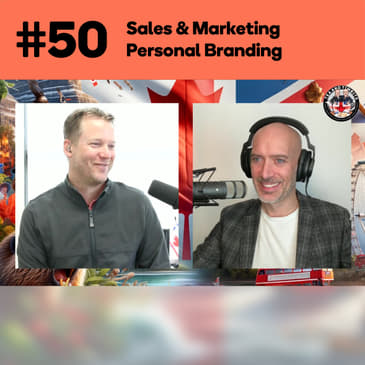
🚨 New Episode Alert! 🚨
Ever feel like you’re juggling two versions of yourself—one for work and one for your personal life? Well, on this week’s episode, we’re breaking down how to bring those two worlds together without losing your sanity (or your job). 🎭
Scott talks about how his agency is revamping for growth—pro tip: always include the client’s perspective! Meanwhile, Andy gives us the lowdown on why aligning your personal and professional values can make you more authentic (and way less stressed).
👉 Tune in for insights on personal branding that don’t require a complete personality overhaul. Catch the episode now, and let’s talk about how you can show up authentically in both your personal and professional life! 💼✨
#PersonalBranding #ProfessionalGrowth #SalesTips #Authenticity #TeaAndTimbits #PodcastLife
[00:00:18] Hello, I'm Andy coming to you from a wet, windy, dry, warm, cold England.
[00:00:25] And I'm Scott coming to you from a lovely, cozy fall day here in Canada.
[00:00:32] I'm sure it's very beautiful.
[00:00:35] It is. The leaves are changing and it feels like a new season is upon us. We definitely get our four seasons here.
[00:00:43] Yeah, that's the nice thing, isn't it? In the proper northern hemisphere, it's the same in Scandinavia as well.
[00:00:48] You see the very distinct difference between all four. Whereas here, it's, yeah, if you're paying attention outside the window, you might get all four in the same day.
[00:00:59] Love it.
[00:01:01] This is the Tea and Timbits podcast, not the Weather Channel.
[00:01:04] And we welcome you to another episode of Global Perspectives on Business Development to help you prosper.
[00:01:10] Welcome.
[00:01:10] This week, we are inspired by my story from last week, going to talk a little bit more about personal branding.
[00:01:16] Uh, but before we get into that, Scott, I think you have a story for us.
[00:01:21] I do. And it has nothing to do with personal branding.
[00:01:23] Uh, so maybe it'll be the segue for the next episode.
[00:01:26] Yeah, let's see.
[00:01:27] Uh, so we are undertaking an exercise, um, at, at my agency at Flywheel to think about how we need to be structured
[00:01:41] and how we need to be postured in order to be able to double in size.
[00:01:46] Um, there's no particular timeline on that, but that's the vision of what we need to be able to do.
[00:01:53] Um, and, uh, and so there's some really great, smart people that are part of our team here that are not me, um, that are working on this.
[00:02:03] Um, and they're, and they're getting all kinds of perspectives and thinking about things.
[00:02:07] And we've had some really good, positive internal conversations, um, which maybe is a different story to share.
[00:02:14] Um, to, to sort of contribute to understanding, uh, that and what needs to change and what, where some of the, uh, obstacles are at the moment.
[00:02:23] Um, and so again, I'm not involved in the, in the project really, except there was a check-in to say, okay, here's what's been done.
[00:02:31] And here's our findings so far.
[00:02:33] And before we move on, wanted to, you know, share this and it was all very good, very smart work.
[00:02:39] Um, but, um, you know, but I said, you know, gently, but firmly, you know, this is, this is all really well and good, but it's, it's missing the client perspective.
[00:02:53] Uh, and, and they kind of went, oh, well, yeah, you're right.
[00:02:57] We didn't, we didn't actually talk to any clients.
[00:03:01] Um, we just sort of looked at our ourselves in the mirror and thought, you know, what are, what are some of our own challenges and pain points or opportunities and whatnot?
[00:03:09] And I said, I, I think doing something of this kind of significance is, is, it's a miss.
[00:03:14] So can, can we incorporate, you know, the client perspective?
[00:03:17] Okay.
[00:03:17] So they went off and I was then involved in like, well, what is the client perspective?
[00:03:21] And, and we got some more detail added, added in.
[00:03:26] And so then they, I, and I felt pretty good after that exercise.
[00:03:29] And then I, and then they said, okay, here's the, you know, the updated draft.
[00:03:33] And it, it had a little bit in there, but I was like, Ooh, like it's still missing.
[00:03:41] So I, I said, okay, like I, I'm going to write this up.
[00:03:45] I'm going to be just, you know, for whatever it's worth.
[00:03:49] Like at this point, I'm like, I just going to take one more crack at this, take it or leave it.
[00:03:53] Maybe I'm distracting you from the process that you set out to do.
[00:03:56] But, but I wrote up, you know, the client's perspective on who we are and why it matters to them.
[00:04:06] And, and when I had written it up that formally and, and, and, and, and articulated it in a way that could be sort of more broadly shared,
[00:04:16] I didn't expect it to have a huge outsized, outsized impact on some of the, some of the processes and internal structures that we do need.
[00:04:26] But if you're thinking about that kind of structural change without a really deep connection with why we even exist as an agency to do what we do for who we do it and what they want and how that works.
[00:04:42] You're going to end up architecting something that may work well, but is not as good a fit as it, as it could be.
[00:04:48] So I, I kind of put up a roadblock, put up a hurdle.
[00:04:54] We slowed down a bit.
[00:04:55] We went through it all together.
[00:04:56] I felt justified.
[00:04:57] I felt validated.
[00:04:59] And I got some good feedback that, you know, it is definitely a perspective worth understanding more, more clearly.
[00:05:06] So for whatever that's worth, thought I'd share it.
[00:05:09] That's an interesting story.
[00:05:11] Thank you very much, Scott.
[00:05:12] I appreciate it.
[00:05:13] We are, as I mentioned, going to be talking about personal branding today.
[00:05:19] And what would you want the listeners to be getting out of that conversation?
[00:05:25] Well, I think the reason that we popped this on was after our last episode and the story that you shared at the beginning about somebody whose personal story was somewhat incongruous with the business story.
[00:05:38] And in the sales position, you have to represent that yourself.
[00:05:43] And I, you know, talked a little bit about that situation and coming across it before.
[00:05:48] And I thought we've probably got more to say about that.
[00:05:49] I think it's entirely possible but often overlooked that those two things can support each other.
[00:05:59] And when done properly.
[00:06:02] And even if they're not congruous, there is a way to be intentional about when you are presenting yourself with sort of one hat on and when you're presenting yourself with another hat on.
[00:06:17] And when it's appropriate to blend those two together and when it doesn't make sense.
[00:06:22] So I don't think people think about this as formally as they should.
[00:06:31] And if, or said another way, I think if people in a business development role and a marketing role in any sort of situation like that, if they did take a moment, it would, one, give them a little bit more personal satisfaction.
[00:06:46] And two, make them more effective at their job.
[00:06:49] So that's what I'm hoping people take away.
[00:06:52] That's very good.
[00:06:52] What steps would you say are necessary in order to achieve a good personal brand?
[00:06:59] Because one of the things I mentioned last week in the story was this situation where it was an extreme disconnect.
[00:07:06] I mean, there's always going to be, you know, a personal life and a professional life.
[00:07:10] And that's absolutely fine.
[00:07:12] From my perspective, it's important that you somehow align those two sort of lives.
[00:07:19] But do you have any sort of tips that you would give to people to make sure that they do that in a good way?
[00:07:26] I'm sort of thinking of it as you even asked the question from two different perspectives.
[00:07:29] One, sort of the sales leader and two, just the individual contributor.
[00:07:33] And so if you are a sales leader, I think one thing you need to do in order to do this well is acknowledge the fact that the scenario exists.
[00:07:40] And you need to probably initiate the conversation with your team and your contributors to say, what's the narrative for you?
[00:07:52] Let's just go over your own story like you did in that last episode.
[00:07:59] And make sure that the people on your team are thinking about that.
[00:08:04] If you're an individual contributor and that's not being done for you or, you know, you want to show more initiative or take it on yourself,
[00:08:14] it's getting really clear for yourself about what those two brands are, my professional self and my personal self.
[00:08:26] And that might make some people's skin crawl just to hear me describe it as two different things.
[00:08:30] Because I also probably more firmly believe that there shouldn't really be a clear distinct.
[00:08:36] You see, I'm going to stop you briefly there because I am very much of the opinion that everything you said is correct.
[00:08:48] But what you're sort of skirting around is the fact that,
[00:08:55] you need to start with finding the core values that align both the professional and personal side of things.
[00:09:03] Because you should have, you know, you should have a personal life that isn't your work.
[00:09:07] And you shouldn't be defined by your work or the company you work in.
[00:09:09] Yes, it's a little different if you're an entrepreneur or you're running a business.
[00:09:13] But nonetheless, there's still an element to you that is separate from the company and separate from the business.
[00:09:19] And I think that's important.
[00:09:20] But there are going to be some core values, some key things that you believe in,
[00:09:24] some key things that tie those together.
[00:09:26] And taking the time to identify those and find those,
[00:09:30] that is where your narrative can lie and that is where you can drive it forward.
[00:09:34] And I would say, try if you can, to build those lists in isolation.
[00:09:40] So if, like, it's kind of hard to do because you already have an understanding of the professional values that you represent,
[00:09:51] at least I hope you do.
[00:09:52] But try to make a list of your own personal values independent from the business context.
[00:09:57] And then work with the business to make sure you've got the right corporate values understood.
[00:10:04] Because sometimes they are different from what you think they are.
[00:10:07] We run into that at Flywheel more often than you might think.
[00:10:12] We're a smaller team.
[00:10:13] And it's still, from time to time, I'm like, ooh, no, that's not how we're trying to be.
[00:10:20] So then compare the lists and then figure out how to fit them together or which pieces fit together.
[00:10:29] Because they don't entirely have to fit together.
[00:10:33] But no, I think you're completely right because they are separate and being separate is key.
[00:10:42] But I also think consistency is necessary as well.
[00:10:47] That once you've sort of defined who you are and how you are both in private and professional side
[00:10:52] and the message that you want to get across, that you have a consistent message.
[00:10:58] So that people don't see it as necessarily that your personal brand is something separate from your professional brand
[00:11:07] or your personal brand is something separate from your private brand.
[00:11:10] And it's an extension.
[00:11:12] They're an extension of each other.
[00:11:14] Right.
[00:11:15] Because they are who you are.
[00:11:17] And you are slightly different in work than you are at home.
[00:11:20] I mean, just imagine taxi drivers.
[00:11:22] God, I don't want them to be the same at home as they are at work.
[00:11:26] Fair point.
[00:11:28] I mean, what I like about this point you've raised about starting with values is I think my hypothesis here is
[00:11:35] the values, if you're talking about a value list specifically, are probably way more congruous than the way you express those values in your personal and your professional life.
[00:11:49] That you're probably going to find way more similarities between just the values themselves than how you represent those values at home versus at work.
[00:12:01] And then it makes it a little easier to be like, oh, I see the alignment here.
[00:12:10] When you do this, though, when you have developed this personal brand, I think you need to have some boundaries as well, don't you?
[00:12:18] I mean, in terms of knowing what you're going to share and not getting too carried away and sharing everything that comes to mind.
[00:12:27] Yeah, I mean, honestly, I think that's a personal preference.
[00:12:30] I mean, some people, depending on the business context, depending on the inter-colleague dynamic,
[00:12:42] you need to make sure there's professional boundaries that exist.
[00:12:46] I don't think you need to have professional boundaries.
[00:12:52] There are certain circumstances where those just need to be very present in your mind and used to govern yourself in a work environment.
[00:13:01] It's very different, although not entirely, from your personal situation.
[00:13:05] But I completely understand that you probably need to have a filter or a fuzzy boundary, a fuzzier boundary about sort of when all your personal details come into work.
[00:13:16] And you certainly need to make sure you've got some of those boundaries at home so you're not bringing your work home with you all the time.
[00:13:22] That's right.
[00:13:22] I think these are, you know, in certain jobs more important than in others.
[00:13:27] You know, for example, if you are a civil servant working for the government, then it doesn't matter which, you know, which party's in charge because your job remains the same throughout and the same if you're in the military and so on.
[00:13:39] Well, I suppose you have personal values that conflict with that.
[00:13:43] Well, then, of course, it's time to leave.
[00:13:46] But certainly don't, you know, you don't.
[00:13:48] Well, don't bring them forward.
[00:13:49] Yeah, you don't make a big point about, oh, I hate the government and all the government are making bad decisions and stuff if you're working for them.
[00:13:56] Right, right.
[00:13:57] You know, those are sort of certain boundaries that you do need to have.
[00:14:01] You know, you can moan about it.
[00:14:02] Fair enough.
[00:14:03] But try and think about the impact that that has to a wider audience.
[00:14:08] I wonder if we have any enlisted individuals that listen to this podcast.
[00:14:14] From a personal brand versus professional brand perspective, though.
[00:14:19] OK, so we got right into that, which that was a great conversation.
[00:14:22] I did want to make sure that in this episode we talked about sort of how to bring forward some of those things and blend them together, because I think that that makes you more authentic and more effective.
[00:14:38] And again, my personal perspective on this, I think other people take a different perspective and I don't have a problem with that.
[00:14:44] But for those who identify with sort of my point of view on this, I used to think more strongly that I was supposed to separate them.
[00:14:52] And now more more.
[00:14:55] It's been quite some time since I got over that, but I still want to make sure I emphasize the point that you do not need to necessarily have a dividing wall between them.
[00:15:05] And I find it much more comfortable to have a tiny, you know, little fence to hop over.
[00:15:13] Yeah.
[00:15:13] Yeah.
[00:15:14] And to talk talking about those.
[00:15:16] But at the flip side, don't feel like just because you do that, you expect other people to.
[00:15:21] I hate it when we start, you know, new introductions and new meetings or things like that.
[00:15:26] And somebody is like, you know, wants to, you know, go on for too long about everybody's weekend and personal stories.
[00:15:33] I'm like, let's get to know each other over time.
[00:15:35] Let's make it a big, big, huge moment right now.
[00:15:40] So I don't know if that sort of goes to your point about sort of having some of those careful boundaries.
[00:15:46] No, it's an element of it.
[00:15:48] But I think there's, you know, more to what you're saying now is it's important to, you know, to be yourself.
[00:15:54] You know, don't be afraid to be who you are and, you know, your little quirks and things that make you you.
[00:16:00] Well, bring those forward.
[00:16:02] You know, don't be afraid of those because those are who you are and what make you you.
[00:16:06] And I know we've both done an exercise together and we've talked about it together on what is my personal brand at work?
[00:16:18] Yeah.
[00:16:19] Right.
[00:16:19] So there's my there's we've talked about sort of the difference between personal life and professional life.
[00:16:24] But then even within the professional setting, how am I showing up?
[00:16:28] What elements are coming forward?
[00:16:31] Not just values, but, you know, what's my story?
[00:16:34] What's my narrative?
[00:16:35] What you know and and how because if you were to if you were to do a marketing campaign or a sales campaign for a business, you would start from that same place.
[00:16:45] What is the brand?
[00:16:46] What does it mean?
[00:16:46] What are the values?
[00:16:49] And all and then and then what's the story?
[00:16:52] Right.
[00:16:53] And it has to line up with the product and the service and the offering and whatnot.
[00:16:56] But you don't do it in isolation.
[00:16:59] So at work, absolutely.
[00:17:01] If you haven't done this before, look for one of those personal branding templates.
[00:17:06] Talk about your personal goals, ambitions, targets.
[00:17:12] Talk about the story that you're comfortable with.
[00:17:17] Figure out how it interlaces with the corporate story.
[00:17:21] Practice it.
[00:17:22] Share it.
[00:17:24] And and I think, again, to reiterate the point I've already made a bunch of times, it'll make you more effective at what you're doing.
[00:17:32] No, definitely.
[00:17:33] I think the last point, though, is be prepared to evolve your brand.
[00:17:39] You know, don't don't remain static.
[00:17:41] You know, don't go, I've done this now.
[00:17:42] That's it.
[00:17:43] I've got to be this person forever.
[00:17:44] I've got to act this way forever.
[00:17:46] No, you know, grow naturally.
[00:17:48] You know, all brands grow, all brands develop, all brands change over time.
[00:17:54] And just make sure that, you know, your core elements remain consistent.
[00:17:58] But everything else, you know, you can adapt and adjust accordingly.
[00:18:00] But the nice thing is, if you've developed these and have an understanding of what your core brand is, it doesn't matter if you change jobs, you know, every three months or six months or 12 months.
[00:18:09] You can still be you without having to fear that you're going to.
[00:18:13] Oh, no, I'm going to have to recreate myself.
[00:18:15] I am and represent myself to my network.
[00:18:18] Yeah.
[00:18:19] Yeah, exactly.
[00:18:21] Any other thoughts on that?
[00:18:23] I think we've covered it.
[00:18:24] Yeah.
[00:18:24] Oh, fantastic.
[00:18:25] Well, that's very good.
[00:18:26] Thank you.
[00:18:27] If anyone has any questions or wants to find any more information about personal branding, anything else that we've talked about today, go to tantinbits.com where you can get in touch with us, subscribe to our future episodes and listen to the 40 odd past episodes.
[00:18:45] It's nearly 50 now, isn't it?
[00:18:47] Yeah.
[00:18:47] Yeah.
[00:18:48] We're getting there now.
[00:18:49] That's amazing.
[00:18:50] We've been doing this consistently for almost a year.
[00:18:53] That's quite impressive.
[00:18:55] Yeah.
[00:18:56] Yeah.
[00:18:57] She's still putting up with me.
[00:19:00] Thank you very much, Scott.
[00:19:02] And we'll see you next week.
[00:19:03] All right.
[00:19:03] Thanks, everybody.